categories
Updated on Published on in

Chrome Remote Desktop vs Splashtop

Author: Oliver Rieder
Oliver Rieder Article author

Chrome Remote Desktop and Splashtop are built for different kinds of users, and it shows what each one skips. Chrome Remote Desktop is fully free through a Google account and handles the basic case of reaching a computer from another device, but it has no in-session chat and no multi-monitor support. 

Splashtop covers more ground with dedicated Remote Access tiers, though those plans are annual-only with payment upfront, and features like multi-monitor view, chat, and session recording are locked behind Pro tier and above.

One is missing basic features, the other locks them behind an annual contract. HelpWire skips both problems: Windows, macOS, and Linux coverage, no personal/commercial-use split, and no forced session cutoffs during active work.

Note:  For this comparison, a technical specialist tested Chrome Remote Desktop and Splashtop in a small hybrid-work and IT support setup with Windows 11 Pro and macOS Sequoia devices. Connections were checked over office broadband, home Wi-Fi, and a mobile hotspot.

Chrome Remote Desktop was tested for quick remote assistance and long-term access to a registered computer. Splashtop was tested in two scenarios: Remote Access Pro for access to a user’s own work computer, and Remote Support, SOS, for attended support with a session code. The test covered unattended setup, reconnect after restart, multi-monitor use, file transfer and remote print where available, macOS permissions, and basic troubleshooting.

Software versions tested: Chrome Remote Desktop extension 2.1; Splashtop Business app 3.8.4.0, Splashtop Streamer 3.8.4.0, and Splashtop SOS app/agent 3.8.4.0. Testing was carried out in late June 2026.

Quick Comparison Table: Chrome Remote Desktop vs Splashtop vs HelpWire

Chrome Remote Desktop Chrome Remote Desktop Splashtop Splashtop HelpWire HelpWire
Leader

Casual personal access inside the Google ecosystem, or one-off help for family and colleagues

IT teams and MSPs ready for an annual paid commitment across Windows/macOS fleets

IT support teams, solo IT providers, and internal SMB IT wanting a support-first workflow without an annual commitment

Reader takeaway

Individual, non-commercial use inside Google’s ecosystem points to Chrome Remote Desktop; annual-budget IT teams with heavy Windows/macOS fleets point to Splashtop; support-first teams wanting to start commercial work without a contract point to HelpWire.

Leader

Fully free, no paid tiers, no commercial-use detection, but consumer-grade features

No permanent free plan for commercial use; 7-day trial only, plus a separate non-commercial Personal product

Free plan covers personal and business support, no split, no nag screens, no session cutoffs

Reader takeaway

Chrome Remote Desktop is free for everyone but stays consumer-grade. Splashtop only lets you evaluate for 7 days before an annual commitment. HelpWire is the only one with an ongoing free plan built for commercial support.

Leader

Windows, macOS, Linux, ChromeOS hosts; iOS/Android as client

Operator app on Windows, macOS, Linux, ChromeOS, iOS, and Android; target Streamer on Windows, macOS, and Xorg-only Linux

Windows, macOS, Linux for both Operator and Client; no mobile apps

Reader takeaway

Chrome Remote Desktop and HelpWire both reach Linux on the target side. Splashtop’s mobile operator reach is the widest of the three, which matters for teams that need to support clients from a phone.

Leader

One-time 12-digit code for attended sessions, or same-Google-account PIN for unattended

Two separate installs (Business/Remote Access app plus Streamer), tied to the same paid team account for unattended access

 Dedicated connection link, no ID, password, or account needed on the client side

Reader takeaway

A link is fewer steps than a code that has to be read aloud or typed in. Splashtop’s two-install setup fits pre-provisioned fleets better than one-off support.

Leader

One session at a time, no chat, no drag-and-drop transfer, single-monitor view

Drag-and-drop file transfer on all tiers; chat, session recording, and multi-monitor view on Pro tier and up

File transfer, multi-monitor, reboot-and-reconnect, and admin elevation at the product level; multiple sessions on paid tiers

Reader takeaway

Chrome Remote Desktop is workflow-thin for professional support. Splashtop has the deepest toolkit once you’re on Pro or higher. HelpWire covers the core support workflow for free.

Leader

End-to-end encryption tied to the operator’s Google account; 2FA lives at the Google account level

 TLS/AES-256, per-operator 2FA, plus SSO/SAML, SIEM logging, and IP whitelisting on Enterprise

TLS/AES-256, per-operator 2FA, DigiCert code-signed apps, consent required before every session

Reader takeaway

All three cover standard encryption and 2FA. Splashtop is the only one with SSO, SIEM logging, and IP whitelisting for teams that need to satisfy a compliance checklist.

Leader

Client must reconfirm sharing every 30 minutes in attended Remote Support mode (confirmed in Google’s own documentation)

No documented forced cutoffs during active work on Remote Access tiers

No session cutoffs, no forced time limits, no software-imposed interruptions during active work

Reader takeaway

Chrome Remote Desktop’s 30-minute reconfirmation is the real risk for longer attended sessions. Splashtop and HelpWire both avoid forced cutoffs, though HelpWire documents the guarantee more explicitly.

Leader

Fully free, no tiers, no billing setup at all

Remote Access billed annually upfront (Solo $72/yr, Pro $99/yr, Performance $149/yr); no monthly option

Free plan permanent; paid tiers add monthly or annual billing for larger teams

Reader takeaway

For zero cost with nothing to manage, Chrome Remote Desktop wins outright. Splashtop’s annual-only billing suits teams planning a year ahead. HelpWire sits between the two: free to start, with billing flexibility if you outgrow it.

Leader

30-minute reconfirmation interrupts longer attended sessions; no chat, drag-and-drop transfer, or multi-monitor

Annual prepayment with 30-day cancellation notice; Linux Streamer is Xorg-only, excluding Wayland-default distributions

No mobile operator apps.

Reader takeaway

Chrome Remote Desktop’s limitation actively interrupts live support work. Splashtop’s is a procurement constraint, not a mid-session one. HelpWire’s gaps are missing capabilities rather than active disruptions, which matters less for most day-to-day support work.

Overview

Chrome Remote Desktop
by Google
4.4 (17)

Chrome Remote Desktop is Google’s free remote access product. It runs through the Chrome browser and a companion extension, with host support on Windows, macOS, Linux, and ChromeOS, and client access from desktop browsers or the iOS and Android apps. There are two flows: Remote Access, where the operator’s own devices are added to their Google account and reached via a permanent PIN, and Remote Support, where the person receiving help generates a one-time 12-digit code. 

  • • Best for: Individuals reaching their own computers from another device, one-off help for family or non-technical colleagues, and casual use inside the Google ecosystem.
  • • Not ideal for: Professional IT support workflows that need in-session chat, drag-and-drop file transfer, multi-monitor view, or long uninterrupted troubleshooting.
Splashtop
by Splashtop
4.5 (90)

Splashtop is a commercial remote access and remote support product built for IT teams, MSPs, and businesses. The product line splits into Remote Access (for connecting to your own devices, previously named Business Access) and Remote Support / SOS (for supporting client devices), with an Enterprise tier for regulated environments. Splashtop requires two separate installations, the Business/Remote Access app on the operator device and the Streamer on the target device, both tied to the same paid team account for unattended access. Remote Access plans (Solo, Pro, Performance) are annual-only with no monthly billing option, though SOS support tiers have introduced monthly billing per recent third-party reporting.

  • • Best for: IT teams and MSPs comfortable with an annual paid model, managing largely Windows and macOS endpoints, and teams needing advanced security controls like SSO or SIEM logging at the Enterprise tier.
  • • Not ideal for: Teams looking for a free plan for ongoing commercial work, monthly billing on Remote Access, or unattended Linux target coverage on modern Wayland-default distributions.

HelpWire: Chrome Remote Desktop and Splashtop Alternative

HelpWire is remote access software built for IT support teams, solo IT providers, and internal IT teams at SMBs. HelpWire’s free plan covers both personal and business support, with no nag screens, no session cutoffs, and no personal/commercial-use split, and paid plans add more for larger teams (see the pricing page for details). The client joins through a dedicated link with no ID, password, or account to set up, and HelpWire runs on Windows, macOS, and Linux for both Operator and Client apps, with unattended access for follow-up work. 

HelpWire avoids forced session time limits during active work and licenses by operator seat, so every operator on a plan can run a session at once.

Key Features
  • Link-Based Session Start:

    HelpWire sends the client a connection link, so they join with no ID, password, or account to set up. Chrome Remote Desktop requires both sides signed into Google accounts for PIN-based access, and Splashtop needs two separate installs tied to the same paid team account.

  • Chat:

    HelpWire includes in-session chat by default. Chrome Remote Desktop has none, and Splashtop's chat is a Pro-tier feature.

  • Cross-Platform Support:

    HelpWire's apps run on Windows, macOS, and Linux, including Wayland-based distributions like Ubuntu 22.04+ and Fedora. Splashtop's Linux Streamer requires Xorg and doesn't support Wayland or headless Linux.

  • File Transfer:

    HelpWire supports drag-and-drop or clipboard transfer. Chrome Remote Desktop only offers a separate Upload/Download menu, not drag-and-drop.

  • Multi-Monitor Support:

    HelpWire lets operators view and switch between multiple remote monitors. Chrome Remote Desktop is single-monitor only, and Splashtop gates multi-monitor behind Pro tier and up. 

  • Reboot and Reconnect:

    HelpWire reconnects automatically after a remote reboot or logout. Chrome Remote Desktop's Remote Support flow uses one-time codes, so a reboot means generating a new code before reconnecting.

Features

1. Remote Access and Session Management

Chrome Remote Desktop offers two modes: a one-time 12-digit code for attended support (asks the client to reconfirm sharing every 30 minutes during an active session), or a persistent PIN for unattended access to your own devices signed into the same Google account. It handles one session at a time, with no fleet or multi-device management.

Splashtop splits this by plan. Remote Access Pro covers unattended access to up to 10 computers per user, with multi-monitor support, session recording, chat, and up to 3 users able to access the same machine at once. Remote Support (SOS) is built for larger fleets, with unlimited attended and unattended access across up to 300 machines and real-time monitoring for IT teams.

2. Performance and Ease of Use

Chrome Remote Desktop runs through the Chrome Remote Desktop web interface, with host components installed on the remote computer. Setup is minimal on both sides.

Splashtop requires two separate installs: the Business/Remote Access app on the operator’s device and the Streamer on the target machine. In exchange, it offers a higher performance ceiling, with streaming up to 60 FPS and, on the Performance tier, 4:4:4 color accuracy for resource-intensive work.

3. Collaboration and File Sharing

Chrome Remote Desktop supports file transfer through a separate Upload/Download menu in the session toolbar, not drag-and-drop between windows, and it supports basic audio streaming from the remote computer. It has no built-in chat and no remote printing.

Splashtop includes drag-and-drop file transfer on every tier, with chat available on Pro and SOS. Remote printing is included on Remote Access Pro but not on SOS, and Pro’s two-user access lets a second person view the same session at the same time, though this is shared viewing rather than a formal hand-off between technicians.

4. Device and Team Management

Chrome Remote Desktop has no device dashboard, no grouping, and no role-based access. It’s built for one-to-one connections, not team administration.

Splashtop adds user role management on Remote Access Pro, covering up to 10 computers per user, while SOS includes device and user grouping tools aimed at fleet-scale support.

5. Customization and Branding

Chrome Remote Desktop has no branding options. The interface is fixed, with no company logo, colors, or custom text for the person receiving support.

Splashtop’s branding depends on the plan: Remote Access Pro offers limited options, while SOS allows full customization with logos, colors, and text for a professional support experience.

Feature Comparison

FeaturesChrome Remote DesktopSplashtop
Mobile accessibilityiOS/Android access app iOS/Android Business app
Session recording Remote Access Pro and SOS
Audio support remote computer audio output high-fidelity audio on Performance; voice call in SOS
Session transfer / collaboration formal hand-off up to 3 users/technicians in one session, depending on plan
File transfer Upload/Download options where available drag-and-drop, copy/paste, and standard file transfer
Real-time chat Remote Access Pro and SOS
Remote printing native remote printing Remote Access plans; not highlighted as a core SOS feature
USB device redirection Performance and Enterprise

Interface Comparison

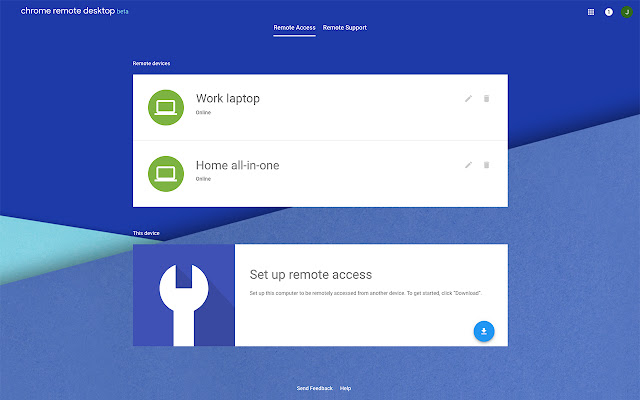
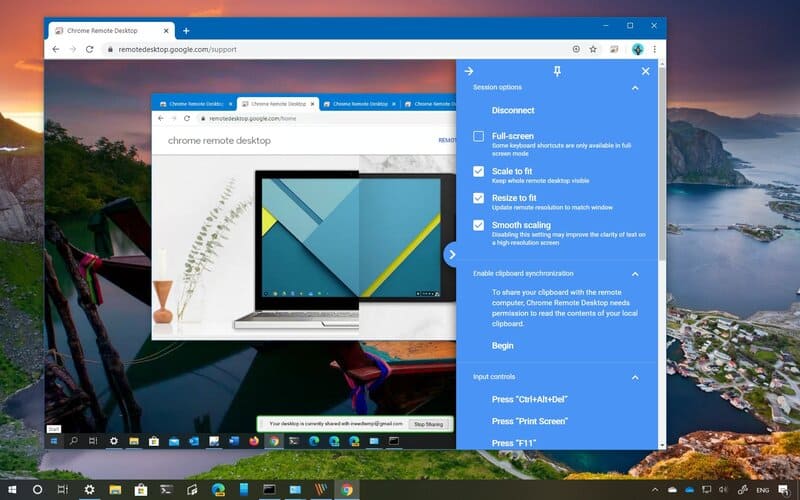
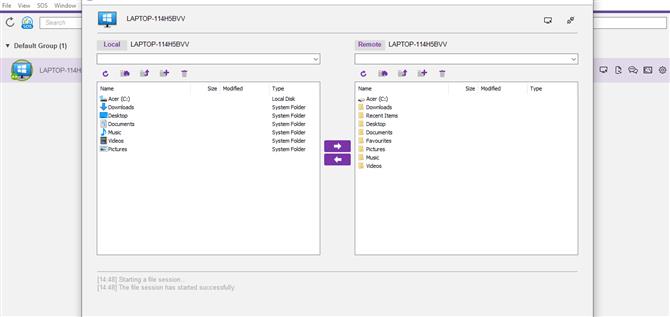
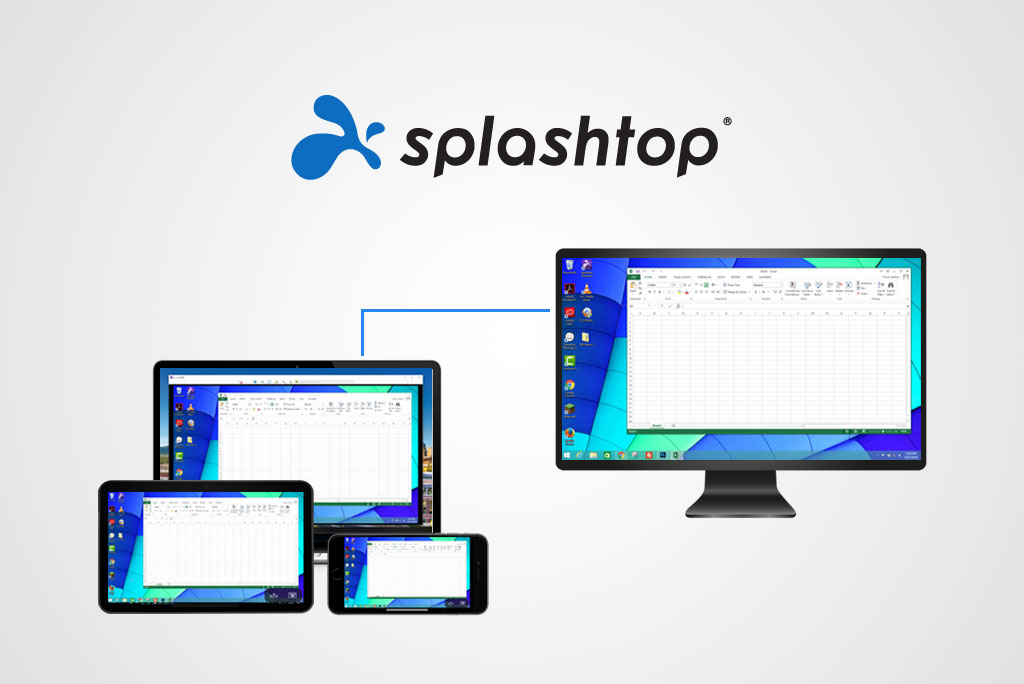
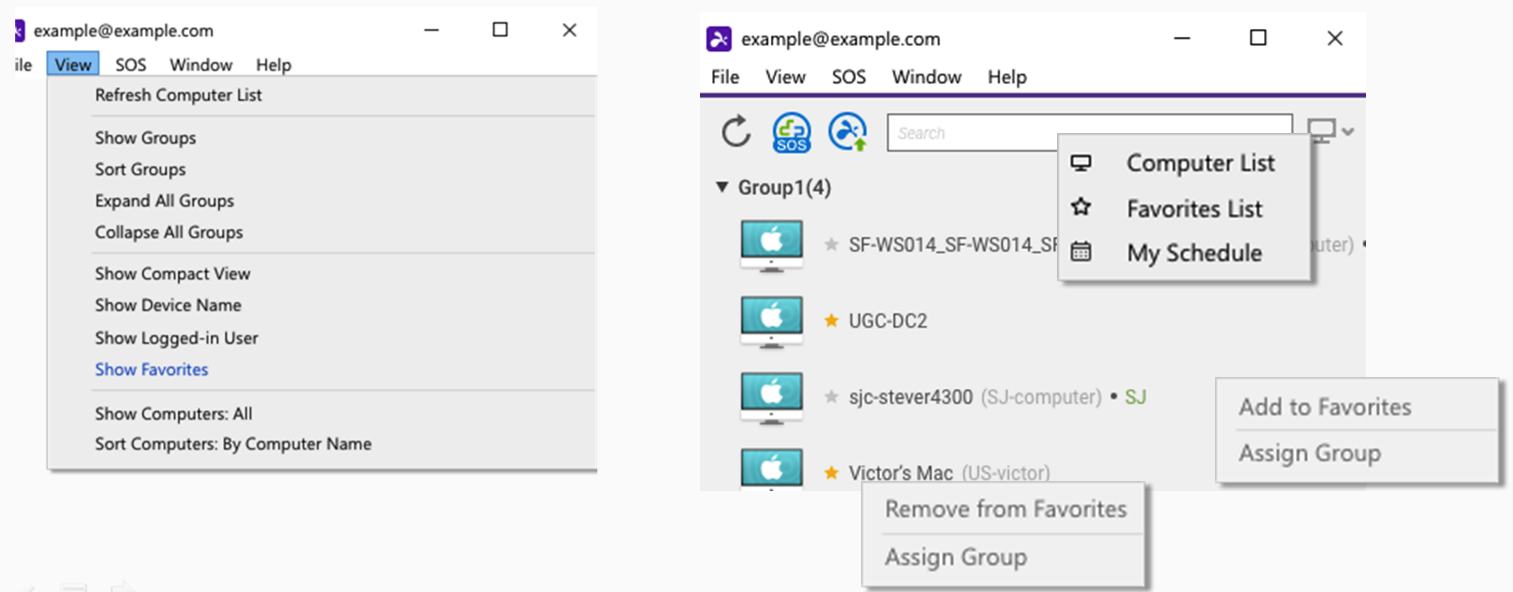
Both Splashtop and Chrome Remote Desktop have intuitive interfaces, which make them easy to work with for all users. Their interfaces offer high-quality image scaling, and you can easily connect to your remote computers  you attach to a peripheral desktop.

Chrome Remote Desktop
Splashtop

Operating Systems

Splashtop and Chrome Remote Desktop both support all major operating systems, as seen in the following table. As well, users will find it extremely useful to compare SplashTop and RDP to access their home machines from another location.

Operating System Chrome Remote Desktop Splashtop
Window
MacOS
Android
Linux
iOS & iPadOS
Chrome OS
RaspberryPi
FireOS

Pros and Cons

Now let’s look at some of the pros and cons of these two remote access solutions. Compare them with the RemotePC and SplashTop apps to make the right choice.

Chrome Remote Desktop

Pros

  • Provides a free remote access solution;
  • Cross-platform compatibility;
  • Uses the familiar Chrome browser interface.

Cons

  • Requires a Google account;
  • No remote printing or file sharing is available;
  • Requires the use of the Chrome web browser.

SplashTop

Pros

  • An intuitive and simple interface;
  • Fast connectivity speeds;
  • Multiple affordable pricing plans;
  • Multi-monitor display support in higher-end plans;
  • Simple drag-and-drop file transfer;
  • Supports multiple operating systems;
  • Strong security with TLS and 256-bit AES encryption;
  • Enhanced security with two-factor authentication and password protocols.

Cons

  • The tool can be complex to install, particularly on systems running macOS;
  • Higher-priced plans are necessary to access advanced features;
  • Premium plans are required to obtain priority technical support.

Price

Chrome Remote Desktop

Chrome Remote Desktop is completely free for users to use with no subscriptions, plans, perks, or premium content. All you need to do is simply sign in to your Google account and configure remote desktop access.

The remote desktop software is available in the form of a Google Chrome extension. Hence, you can use it on any computer with Chrome support. To enable remote access, pair the target computer device or remote computer with another computer or a mobile device (iOS or Android).

Splashtop

Splashtop offers a bunch of plans for users with varying needs. All plans include a 7-day free trial.

Splashtop Work & Access Plans: These plans range from $60 to $149 per year (per user) and allow remote access to computers from any location. The available tiers in this category are Solo ($60/year), Pro ($99/year per user), and Performance ($149/year per user), each with progressively more advanced remote access and collaboration features.

Splashtop IT & Support Plans: These plans range from $259 to $399 per year (per concurrent technician) and provide unlimited on-demand (attended) support sessions, as well as unattended remote access to a specified number of Windows and macOS computers, depending on the tier selected.

Splashtop Education Plans: Designed for educational use, these plans (e.g., Classroom Cloud) typically cost $29.99 per teacher per year and offer screen-sharing and classroom collaboration tools.

For organizations with advanced remote access and support requirements, Splashtop Enterprise licensing and pricing are available upon request through the Splashtop sales team.

Pricing plansChrome Remote DesktopSplashTop
Free Version
Free TrialIt’s Always Free7 days
Level 1N/A$6/month/user
Level 2N/A$8.25/month/user
Level 3N/A$13/month/user
Level 4N/A$259/year/technician (SOS)
Level 5N/A$399/year/technician (SOS+)
Level 6N/ACustom pricing

Conclusion

Chrome Remote Desktop works for casual, one-off remote access at no cost, but its 30-minute reconfirmation prompt and missing chat, drag-and-drop transfer, and printing make it a weak fit for ongoing support work.

Splashtop covers session recording, remote printing, and multi-monitor support, but only on Pro tier and up, and its Remote Access plans require a full year paid upfront with no monthly option.

HelpWire is closer to what solo IT providers and small support teams need: a free plan built for business use, no annual commitment, and unattended access without the account-sharing Chrome Remote Desktop requires. Its own gaps are real too: no mobile operator apps and no public compliance certifications, so teams that specifically need those should weigh that before switching.