Trying to decide which between RemotePC and TeamViewer is ideal for your work or IT assistance? Read on.
Below, we’ll break down both tools, including their main plans for individuals and teams, to help you figure out which one fits how you work better.
Upon reading this article, you can:
- • See the main differences between RemotePC and TeamViewer to decide which one of these two you can use for personal or business projects.
- • Get a clear idea of the main features of each platform to know how each one works.
- • Look at the pricing for RemotePC and TeamViewer to get a sense of which one is the better deal.
- • Figure out which remote desktop software is right for your setup with confidence.
Overview
It helps to know how RemotePC and TeamViewer function before we compare them.
Both are remote desktop apps that let you access and control computers wherever you are. They come with secure connections, file sharing, and multi-device management, which is a big help for IT admins, remote workers, and support staff.

Ideal for: Small businesses, freelancers, and IT teams that need a dependable and cost-effective remote desktop access that can grow with their needs.

Ideal for: Businesses and IT teams looking for a strong remote access solution that has advanced tools for collaboration, monitoring, and integration.
Features
Let’s look at how RemotePC and TeamViewer handle single-user and team licenses to see which remote desktop tool works best for you.
1. Remote Access & Session Management
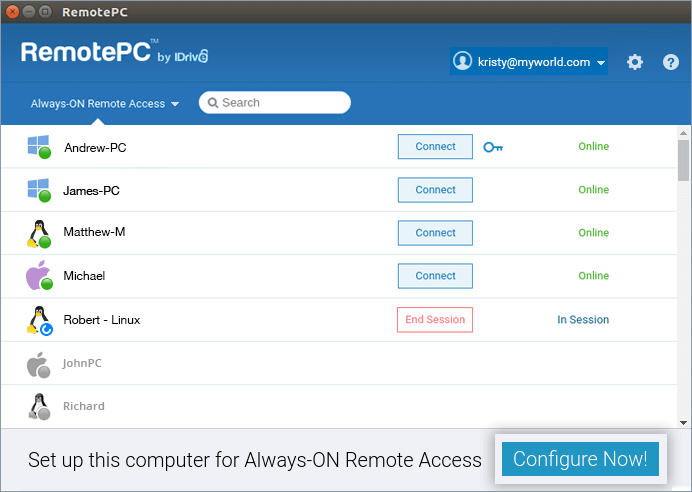
RemotePC offers attended and unattended access, which makes it convenient for users to connect to remote computers both with and without someone on the other end. Its “Always-On Remote Access” feature lets you reach devices without needing anyone to approve, which is perfect for IT tasks and server upkeep.
It also offers multi-monitor support, session recording, and remote reboot, and together, they help reduce the hassle of managing sessions.
In the Team plan, admins can handle several ongoing sessions at once and have technicians handle different devices at the same time to get issues fixed faster.
TeamViewer works similarly to RemotePC, providing attended and unattended access along with session recording. Its multi-session tabbed interface helps technicians manage several connections simultaneously.
The software also allows session transfers between users, which is helpful when working as a team.
Both platforms use strong encryption and require device authorization to keep connections secure from the moment they start.
2. Collaboration & File Sharing
RemotePC makes teamwork easier by letting you chat, make voice and video calls, and use a whiteboard for collaboration. These improve how users communicate during remote sessions.
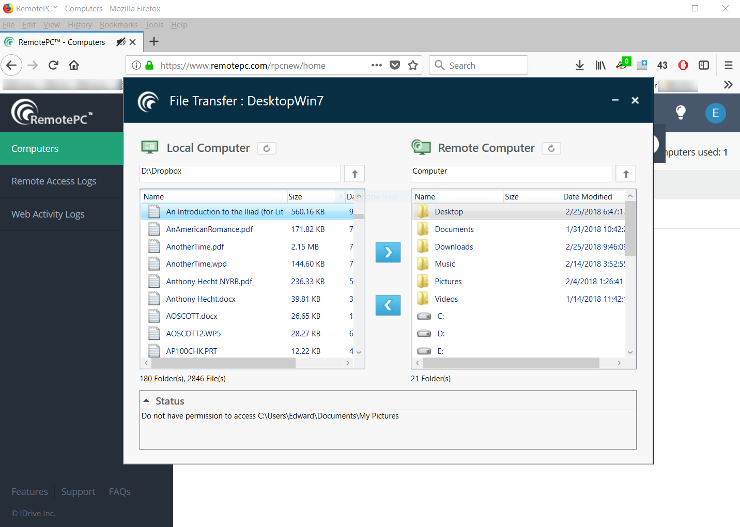
Its drag-and-drop file transfer feature also ensures smooth sending between local and remote devices. Remote printing is possible with RemotePC as well. This means users can print files from a remote computer straight to a local printer.
TeamViewer performs well in this area too, offering file transfers with clipboard syncing and remote printing. There are even live communication tools like chat, VoIP, and video calls.
The software also allows multiple technicians to work on a single device at the same time. There is no doubt that the app is a strong choice for business and managed service setups.
3. Customization & Branding
RemotePC offers simple but practical customization options, mainly in its Team and Enterprise plans.
Businesses can add their own names, logos, and welcome messages to remote session windows. This helps keep branding consistent when working with clients.
Admins can also set up custom invite links, adjust permissions, and choose default session settings for technicians.
Even without full white-label options, small teams can use these capabilities to make it easier for small teams to come across as professional while assisting customers.
TeamViewer goes a step further with advanced branding features that give businesses more control over personalizing the interface.
Companies can add their brand colors, logos, and business details to the connection portal.
TeamViewer’s custom modules, like QuickSupport or Host, let partners roll out branded access tools for end-users. This creates a consistent experience across support sessions.
This makes TeamViewer a strong option for MSPs and IT service providers that need consistent branding throughout their support workflows.
4. Performance & Ease of Use
RemotePC installs quickly and doesn’t use many system resources.
It’s built for fast connections and stays stable even on slower networks with the help of adaptive compression.
The app has a clean, simple interface, which means new users can get started (no technical training needed).
With always-on access in RemotePC, connecting is instant. This means there’s no extra setup needed each time.
TeamViewer has a ton of features that offer top-notch performance. Its larger toolset might take a little time to get used to.
Its optimized protocols keep connections fast and responsive, no matter the distance, though occasional lag can happen on limited networks.
TeamViewer’s dashboard offers lots of options for monitoring, file transfers, and organizing devices, which makes it perfect for IT teams.
For casual users, though, this many features can feel a bit overwhelming compared to RemotePC’s straightforward setup.
5. Team & Device Management
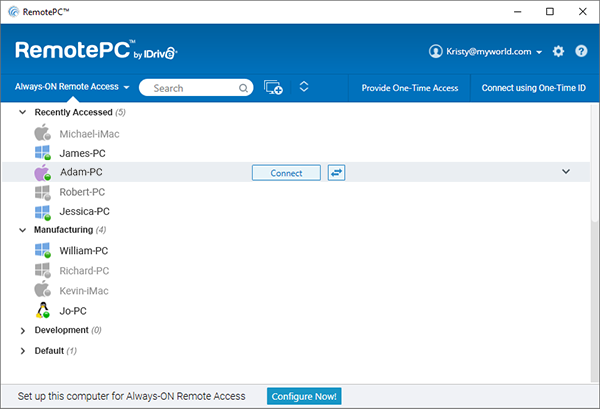
The RemotePC Team comes with a single web-based management console that brings all connected computers into one place.
Admins can add, change the name, and organize devices. They can set permissions based on roles and see who’s currently connected.
Enabling unattended access on devices gives supervisors full control over who connects and at what times.
Technicians can use one-time access links to run temporary sessions, keeping operations both secure and flexible.
For small and mid-sized teams, this setup helps see and manage everything without a complicated IT system.
TeamViewer, meanwhile, offers a complete device management suite that’s designed for bigger organizations.
Its Management Console lets large organizations monitor hardware, enforce policies, and assign roles with robust access controls.
TeamViewer’s collaboration features let multiple technicians work on the same endpoint at the same time.
Its tools for device grouping and session assignment are especially helpful for MSPs overseeing dozens or even hundreds of clients.
Feature Comparison: RemotePC and TeamViewer
| Feature | RemotePC | TeamViewer |
|---|---|---|
| Mobile Access (including mobile-to-mobile) |
|
|
| File Transfer | ||
| Concurrent Sessions |
SOHO: 1
Team: multiple |
Business: 1
Premium: up to 3 |
| Session Transfer | (Team plan) | |
| Session Recording | ||
| Real-time Chat | ||
| Remote Printing | ||
| Audio Support | ||
| Device & User Management | Team and above | Business and above |
| USB Sharing | (via advanced settings) |
Interface Comparison
RemotePC focuses on keeping things simple.
Its dashboard is easy to navigate and displays connected devices and session controls. You’ll also see quick-access buttons right away.
The layout is simple enough for beginners to navigate, and all key tools remain easy for technicians to access from the control panel.
RemotePC’s lightweight client loads fast and performs well across both desktop and mobile devices.
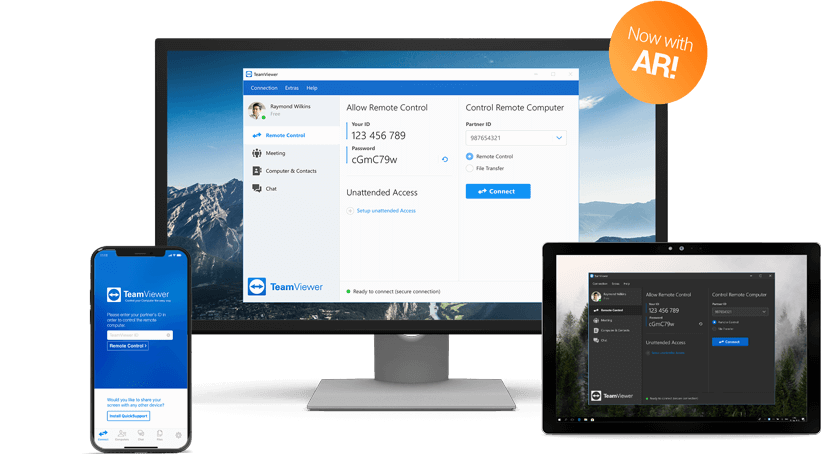
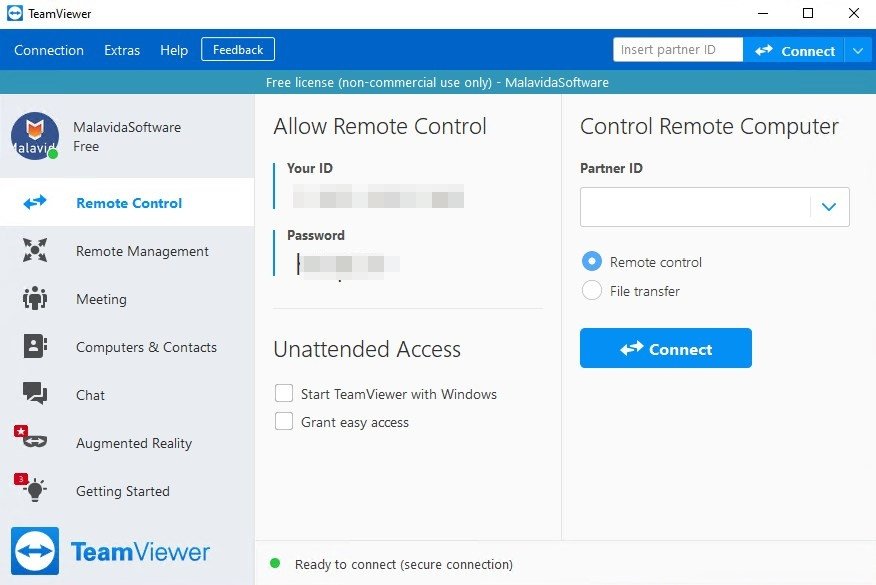
TeamViewer, by comparison, offers a more feature-rich interface designed for professionals to use.
It includes a tabbed session view, a built-in chat panel, and plenty of admin shortcuts.
While it can feel more complicated at first, this setup helps teams handle multiple tasks and manage more than one remote computer at the same time.
For solo users, they might need more time to adjust. Once they do, the productivity benefits are clear.
Operating System Support
Check that the remote desktop tool works with the devices you plan to use before making a choice.
The table below shows OS compatibility for RemotePC (SOHO & Team) and TeamViewer (Business & Premium).
| Operating System | RemotePC SOHO & Team | TeamViewer Business & Premium |
|---|---|---|
| Windows | ||
| macOS | ||
| Linux | ||
| Android | (app available on Play Store) | |
| iOS | (app on App Store) | |
| Chrome OS | Limited (web client only) | Limited (web client only) |
| Raspberry Pi | (ARM version) | |
| FreeBSD |
- • Both programs work across platforms and run smoothly on desktop and mobile devices.
- • RemotePC provides apps for Windows, macOS, Linux, iOS, Android, and Raspberry Pi.
- • On Chrome OS, both programs work directly in your browser.
- • TeamViewer supports a wider range of enterprise setups, including specialized hardware and IoT devices.
Security
Be careful to pick a remote access tool that protects your connections. These solutions often access sensitive systems and information.
RemotePC and TeamViewer both offer strong protection to help keep your connections secure.
We’ll take a closer look at how each tool keeps data safe, confirms user identities, and meets compliance rules.
RemotePC SOHO and Team Security
- • TLS v1.2 / AES-256 Encryption: All communications are fully encrypted, on par with the security standards of online banking.
- • Personal Key Protection: You can create a private password to enter before you start a session.
- • Two-Factor Authentication (2FA): Provides an additional step to confirm your identity.
- • Trusted Devices: Users can approve specific computers or mobile devices to prevent unwanted logins.
- • Idle Session Timeout: Any session left idle will automatically close to maintain security.
- • Role-Based Access: Admins can assign detailed permissions, like “view only,” “file transfer,” or “full control.”
- • GDPR and HIPAA Compliance: Meets data handling standards required for EU and healthcare environments.
TeamViewer Business and Premium Security
- • AES-256-bit Session Encryption: All sessions are encrypted to keep data safe during transfer.
- • Two-Factor Authentication: Logging in needs an extra verification step using an authenticator app or SMS.
- • Device Authorization & Whitelisting: Only devices you trust can connect. Meanwhile, those that aren’t recognized will raise a warning.
- • One-Time Passwords (OTP): Temporary codes provide extra control for occasional sessions.
- • Session Recording & Audit Trails: Tracks activity for compliance and training.
- • Security Certifications: Meets GDPR, ISO 27001, SOC 2, and HIPAA standards.
- • Advanced Access Controls: Admins can assign roles and set policies. They can manage access levels for teams and devices, too.
Usage Scenarios
From personal productivity to business IT operations, both RemotePC and TeamViewer support a variety of applications. Below is a look at how their main licensing plans are designed.
RemotePC
- • SOHO License: Designed for individuals or freelancers who want to connect to their home or work computers. Comes with a single active session, file transfer capabilities, and mobile access.
- • Team Plan: Perfect for small and mid-sized businesses. This plan lets several users access devices, organize them into groups, and manage everything from the web-based admin console.
- • Enterprise / MSP Plans: Built to grow with larger teams, offering detailed reports, API integrations, and options for white-label customization.
TeamViewer
- • Business License: Ideal for individual users who need reliable and secure remote access with a single active session.
- • Premium License: Supports three sessions at a time and includes additional reporting plus tools to organize and manage team members.
- • Corporate / Tensor Plans: Made for enterprises requiring large-scale rollout, advanced monitoring, and integration with third-party systems.
Integration
| Integration Feature | RemotePC SOHO | RemotePC Team | TeamViewer Business | TeamViewer Premium |
|---|---|---|---|---|
| API Access | Limited | Basic API for automation | Basic | Advanced API suite |
| ITSM Integration | Basic ticket integration (e.g., Freshdesk, Zendesk) | Basic | Full (ServiceNow, Jira) | |
| CRM Integration | Via third-party tools (Zapier, Zoho) | Partial | Native (Salesforce, Zoho CRM) | |
| Workflow Automation | Basic scripting | Basic | Advanced automation | |
| Third-Party App Compatibility | Basic (Slack notifications) | Standard (Slack, Zapier) | Basic (Teams, Zendesk) | Broad (Teams, Salesforce, Zendesk) |
| White-Label Branding | Limited | |||
| Admin Console / User Management | Web dashboard | Full | Console | Full Console |
| Ticketing Systems | Basic (Freshdesk, Zendesk) | Basic | Full support | |
| SDK / Developer Tools | Limited | Extensive |
Pricing
RemotePC
- • Free: $22.12 First year
- • SOHO –$74.62/year: For a single user; supports unlimited devices, file transfers, session recording, and mobile-to-PC access.
- • Team – $224.62/year: For several users; simultaneous sessions, central dashboard, and role-based permissions.
- • Enterprise – $449.62/year: Includes advanced reporting, custom branding, API integration, and priority assistance.
- • MSP – Custom Pricing: Designed for managed service providers. Each client can be billed separately.
TeamViewer
- • Free (Personal Use Only): Can only be used for non-commercial purposes.
- • Business – $24.90/month: For one user; allows a single active session; includes features for managing devices.
- • Premium – $50.90/month: Supports up to three sessions; features improved device monitoring and reporting.
- • Corporate – $229.90/month: Lets multiple users connect; has extended service case management.
- • Tensor – Custom Pricing: Built for large organizations, offering deeper system connections and stronger security features.
Pricing Comparison Table: RemotePC vs TeamViewer
| Pricing Tier | RemotePC | TeamViewer |
|---|---|---|
| Trial | 7 days | 14 days (for paid plans) |
| Free Personal Use | ||
| Level 1 | $22.12/year | $24.90/month |
| Level 2 | $74.62/year | $50.90/month |
| Level 3 | $224.62/year | $112.90/month |
| Level 4 | $449.62/year | $229.90/month |
| Top-Tier | Custom | Tensor (Custom) |
Possible Errors and Restrictions
RemotePC
- • Limited Integrations: You will get advanced CRM and automation tools with only high-level plans.
- • Network Latency: Small delays can occur on slower connections even though adaptive compression is used.
- • Browser Access Restrictions: Not every desktop app feature is in the web version.
- • Free Trial: Unlike TeamViewer’s 14-day trial, the free trial lasts only 7 days.
- • Concurrent Sessions: Only one session can run with the SOHO plan. To use multiple sessions, you’ll need the Team plan or above.
- • Firewall Configurations: Some enterprise firewalls might need manual adjustments to allow connections.
TeamViewer
- • Commercial Use Check: The free plan will end sessions if it detects you’re using it for business tasks.
- • Session Limits: Business plans limit the number of active sessions.
- • Network Blocks: Certain proxies or firewalls can block connections.
- • Forced Updates: Updates may occasionally interrupt ongoing sessions.
- • Version Compatibility: Both devices need to run compatible versions for smooth operation.
- • Cost: Small and medium businesses might find advanced plans a bit expensive.
Pros and Cons
Pros
- Budget-friendly pricing works well for startups and small businesses compared with similar tools.
- Lightweight client that gets installed right away and runs on almost any device.
- High performance that holds up on slower connections.
- With most plans, there’s no limit on the number of devices per account
- Built-in tools for file transfers, remote printing, and chat.
- Works across platforms, including mobile devices and Raspberry Pi.
- “Always-On” access lets you connect to unattended systems quickly.
Cons
- Free trial lasts only 7 days.
- Advanced options (including CRM, API access, and custom branding) come only with higher-tier plans.
- Web browser access comes with fewer features than the desktop app.
- The SOHO plan allows only one active session at a time.
- No options for configuring local proxies or gateways in complicated network setups.
TeamViewer
“It's simplified,trustable,innovative and my silver bullet with remote connectivity on the Move.”— Read full review
Splashtop
Pros
- Free to use at home or for personal projects.
- Compatible with many platforms, including IoT and embedded devices.
- Supports several sessions and makes real-time collaboration possible.
- Built-in chat, VoIP, and video calling features.
- Easy to install and update without requiring router setup.
- Offers branded connection modules, like QuickSupport and Host, that can be tailored for each client.
- Strong customer support and detailed guides.
- Perfect for big organizations managing complicated IT environments.
Cons
- For the best experience, you’ll need a reliable, fast internet connection.
- Small teams could find commercial plans a bit pricey.
- Devices using different versions may have connection issues.
- Forced updates can sometimes interrupt long sessions.
- Sending big files may not be a success on restricted networks.
- Advanced features, like monitoring and service case management, are limited to higher-tier plans.
HelpWire: Strong Alternative
RemotePC and TeamViewer make remote access easy, though beginners often struggle with setup. The costs can also add up quickly, and they lack some features. Here, HelpWire comes in as an alternative worth considering.
A modern remote desktop tool, HelpWire lets IT teams access devices quickly and securely, without the usual headaches.
It’s great for those who want enterprise-level features that don’t have expensive licenses or the difficulties of complicated setups.
Main Features
-
Quick remote accessSessions stay smooth, including times when the network isn’t strong.
-
Works across platforms:
-
Session logs and reports:Activity can be tracked for audits and training. This also helps meet compliance requirements.
-
File sharing and chat:Send files and engage with other people securely during sessions.
-
No software installation required:Launch a session immediately using a safe web link.
-
Reach devices anytime, without someone on the other end.
-
Sessions use end-to-end encryption for security. You also get two-factor authentication and Auth0 integration.
HelpWire works well for both individuals and businesses, and it doesn’t cost anything to use. It’s fast, secure, and easy to get started with. That combination makes it a solid alternative to RemotePC and TeamViewer.
RemotePC