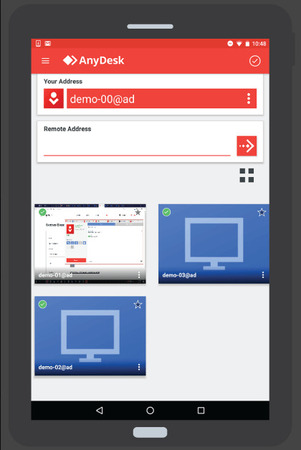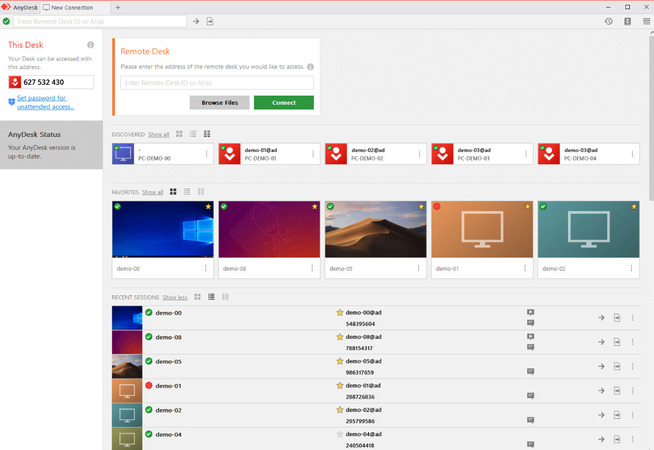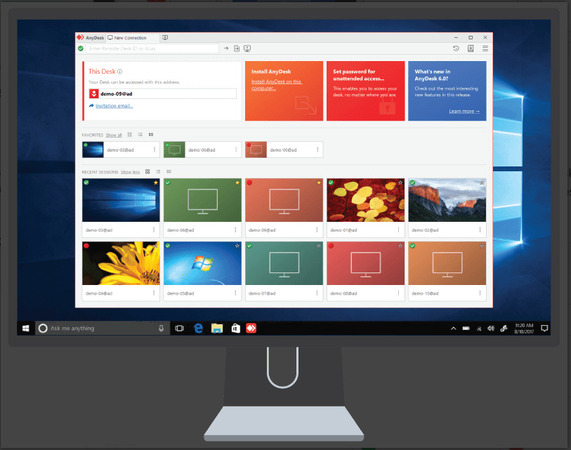
AnyDesk and Zoho Assist both support attended and unattended remote access, but they differ significantly in how sessions start, what their free plans include, and how business use is licensed. AnyDesk is a lightweight remote desktop app with broad platform coverage, including Windows, macOS, Linux, mobile devices, FreeBSD, and Raspberry Pi. Connections start through a numeric device ID or alias, which the remote user must find and share with the technician. Its free version is limited to personal use, and sessions may be restricted when commercial activity is detected.
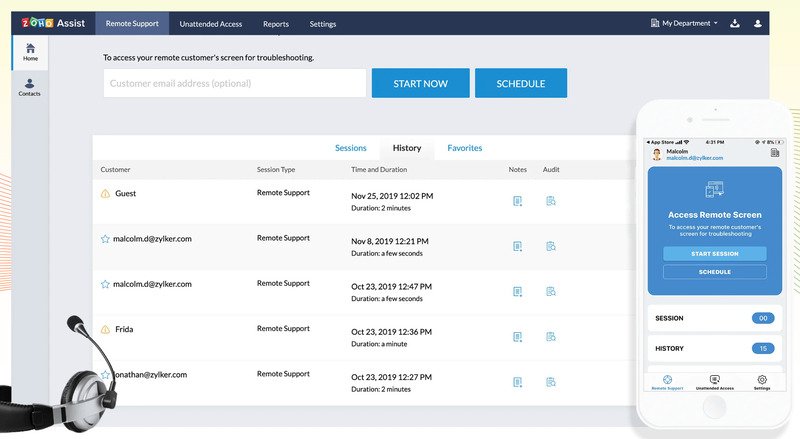
Zoho Assist takes a cloud-based approach, with separate plans for Remote Support and Unattended Access. Technicians can manage sessions from a browser-based console, while unattended endpoints require an installed agent. Its free plan supports one technician and five unattended computers, but file transfer and reboot/reconnect require a paid tier.
HelpWire removes both of these free-plan limitations. Its free plan covers personal and business support and includes file transfer, unattended access, and reboot/reconnect, with no commercial-use flagging or session cutoffs. For attended support, the operator sends the client a Quick Connect link. The client clicks the link, runs the app, and approves the connection, with no device ID to exchange, no client account, and no prior setup required.
Both products were evaluated for attended and unattended support, file transfer, reboot and reconnect, multi-monitor handling, and remote administration. AnyDesk was additionally tested for ID-based remote access and remote printing, while Zoho Assist was tested for browser-based technician sessions, scheduled support, and unattended device management.
Software tested: AnyDesk 9.6.2 for Windows and macOS, Zoho Assist Technician Console (HTML5/Web Client) with Windows Unattended Agent 2026.4.15.0. Testing was carried out in late June 2026.
Quick Comparison Table: AnyDesk vs Zoho Assist vs HelpWire
The table below compares AnyDesk, Zoho Assist, and HelpWire across the categories that matter most in a remote support workflow, including free plan coverage, connection setup, unattended access, security, and day-to-day technician experience.
|
|
Zoho Assist
|
HelpWire
|
|---|---|---|
|
Best for
|
||
|
|
||
|
Individuals and small teams needing a fast, lightweight remote desktop app with broad platform coverage. |
IT teams and MSPs needing cloud-based remote support with helpdesk integrations and flexible attended and unattended licensing. |
IT support teams, solo providers, and SMB IT teams wanting business-ready remote support without commercial-use restrictions. |
|
Takeaway AnyDesk fits users prioritizing speed and broad platform support. Zoho Assist fits IT teams already using Zoho products or needing helpdesk integrations. HelpWire fits teams that want business-ready remote support with a free plan and fewer licensing restrictions. |
||
|
Free plan coverage
|
||
|
|
||
|
Personal use only. Commercial activity triggers session restrictions. File transfer and session recording require a paid plan. |
1 technician, 1 concurrent session, 5 unattended computers. File transfer and reboot/reconnect require a paid plan. |
Personal and business support. File transfer, unattended access, and reboot/reconnect included. No personal/commercial split. |
|
Takeaway HelpWire is the only product here whose free plan explicitly supports business use together with unattended access, file transfer, and reboot/reconnect. AnyDesk limits free use to personal scenarios, while Zoho Assist reserves some support features for paid plans.. |
||
|
Connection setup
|
||
|
|
||
|
Numeric device ID or alias. Portable executable available without installation. |
Technicians work from a browser-based console. Attended sessions start through a session link or ID, while unattended access requires an installed agent. |
Session link sent to the client. No ID, password, or account required on the client side. |
|
Takeaway HelpWire has the least client-side friction for one-off or first-time sessions. AnyDesk portable mode is fast for experienced users. Zoho Assist attended sessions are browser-based, but unattended setup requires an agent install. |
||
|
Platform support
|
||
|
|
||
|
Windows, macOS, Linux, FreeBSD, Raspberry Pi, iOS, Android, ChromeOS (viewing only). |
Windows, macOS, Linux, iOS, Android, ChromeOS, web-based sessions. |
Windows, macOS, Linux (Wayland and X11). No mobile app. |
|
Takeaway AnyDesk covers the widest range including mobile and embedded platforms. Zoho Assist adds web-based sessions. HelpWire covers all three major desktop OSes with no mobile app. |
||
|
Unattended access
|
||
|
|
||
|
Solo tier and above. 100 managed devices on Solo. Not available on the free plan. |
Free plan: 5 computers. Standard Unattended: 25 computers, unlimited technicians, $10/month. Reboot/reconnect on paid tiers only. |
Included on the free plan. Reboot/reconnect after restart included. Admin privilege elevation on Windows included. |
|
Takeaway HelpWire includes unattended access with reboot/reconnect on its free plan. AnyDesk requires a paid tier entirely. Zoho Assist free covers 5 computers but cuts off file transfer and reboot/reconnect until paid. |
||
|
Core support workflow
|
||
|
|
||
|
Remote control, file transfer (paid), session recording (paid, Windows only), remote printing (paid), whiteboard, chat. |
Remote control, file transfer (Standard+), session recording (Standard+), reboot/reconnect (Standard+), voice and video chat (Enterprise), annotation (Professional+). |
Remote control, file transfer, in-session chat, unattended access, reboot/reconnect, Windows admin elevation, multi-monitor support. |
|
Takeaway Zoho Assist offers the broadest remote support feature set among the three, particularly on higher paid tiers. AnyDesk covers the basics on paid plans. HelpWire covers the complete remote support workflow on its free plan, without session recording. |
||
|
Security
|
||
|
|
||
|
TLS/AES-256, 2FA, access control lists, code-signed applications. |
SSL/AES-256, 2FA, role-based access controls, audit logs, SOC 2 Type II. HIPAA available on Enterprise. |
TLS/AES-256, Auth0 authentication, 2FA, DigiCert-signed apps, P2P with encrypted relay fallback, consent-based access. |
|
Takeaway Zoho Assist is the strongest choice for regulated environments with SOC 2 Type II and HIPAA on Enterprise. AnyDesk and HelpWire both cover standard encryption and 2FA with no published compliance certifications. |
||
Overview
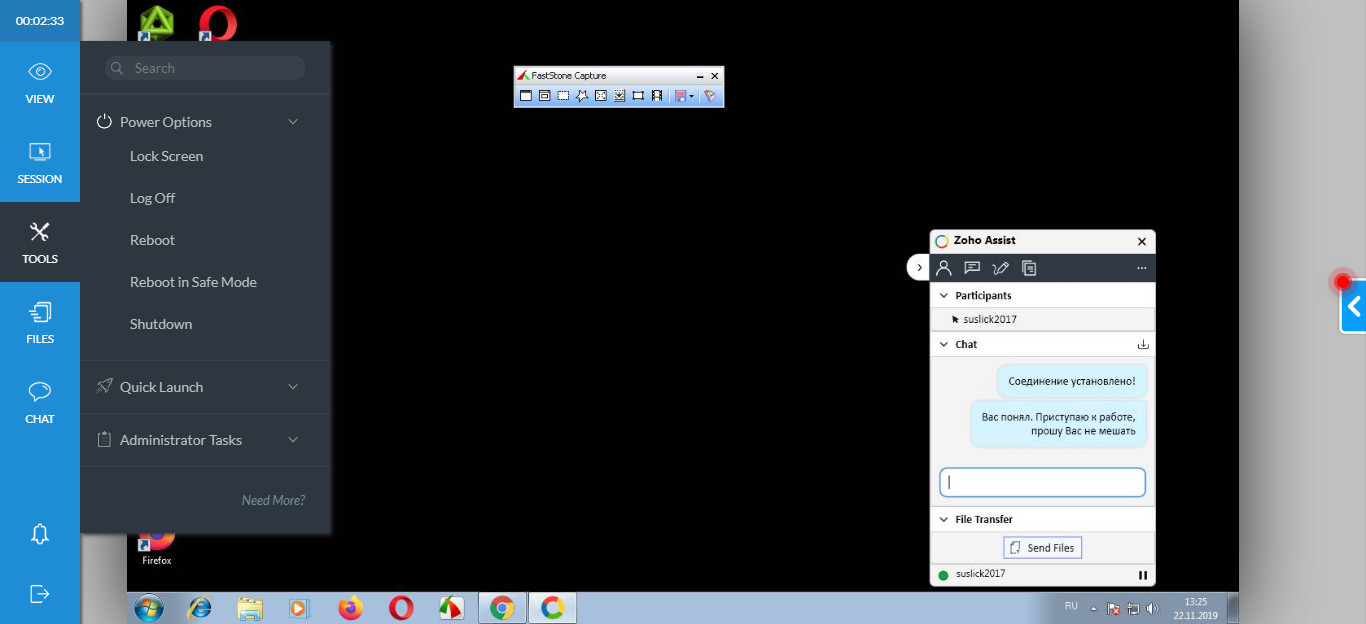
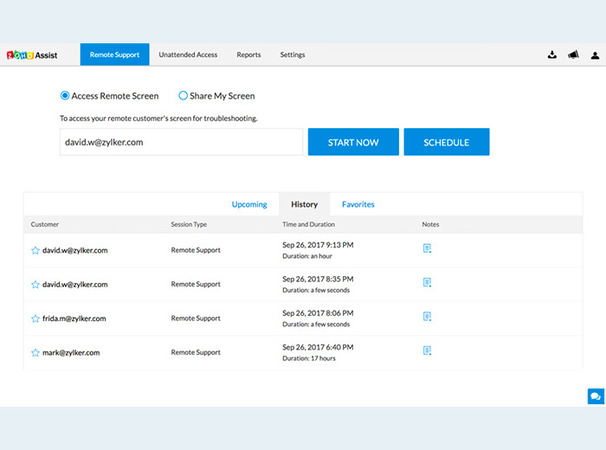
Zoho Assist is a cloud-based remote support tool built for on-demand and scheduled sessions. It runs in a browser with no installation required on the client side. Core features include screen sharing, file transfer (Standard and above), and in-session chat. The free plan covers 1 technician and 5 unattended computers, with file transfer and reboot/reconnect locked behind paid tiers. If you are comparing Zoho Assist Free vs Paid, Zoho offers several pricing tiers to match different support needs and team sizes.
Best for: IT teams and MSPs already in the Zoho ecosystem, or teams needing helpdesk integrations with tools like Zendesk, Jira, and ServiceNow.
Not ideal for: Teams needing Linux host support, or anyone on the free tier who needs file transfer or session reboot without upgrading.
AnyDesk is a lightweight remote desktop application with a strong reputation for performance on low-bandwidth connections. It connects via a numeric device ID. The remote device must be running AnyDesk and share its ID before a session can start. The free tier is restricted to personal, non-commercial use, and AnyDesk has documented enforcement suspending sessions when commercial use is suspected. Paid plans start at $28.90/month (Solo).
Best for: Individuals and small teams needing fast, reliable remote desktop access across a wide range of platforms, including Windows, macOS, Linux, iOS, Android, ChromeOS, FreeBSD, and Raspberry Pi.
Not ideal for: Business use on the free tier, as AnyDesk actively detects and restricts it. Teams needing a session link workflow for non-technical clients will also find the ID-exchange model adds friction.
Features
Zoho Assist
Zoho Assist includes multi-screen support – allowing you to access various devices simultaneously. Every session can be recorded, and all support activities are logged for your internal records and training. Zoho Assist uses Two Factor Authentication (2FA) to provide additional security. These measures can include the user receiving an SMS or One Time Pin (OTP). There are no downloads or installations required to use Zoho Assist as it is cloud based. This means there’s no issues around upgrades and version compatibility. All communications that occur within the Zoho Assist environment are encrypted using SSL and AES 256-bit encryption. Firewalls are also not an issue when using Zoho Assist and easily configured.
AnyDesk
AnyDesk provides an alternative for remote desktop requirements. Similar to other products like TeamViewer, AnyDesk is a lightweight application that is only 2.8MB. The file must be downloaded but installation is not required. Simply run the application from the downloaded file. AnyDesk offers a free for personal use and a paid subscription model for businesses. AnyDesk allows you to collaborate and own your network, quickly and securely. All sessions are recordable.
| Feature | Zoho Assist | AnyDesk |
|---|---|---|
| Transfer Files |
|
|
| Record Sessions | (Windows only) | |
| Supports Audio | ||
| Transfer Sessions | ||
| Print Remotely | ||
| Share USB | ||
| Allow Real-Time Chat | ||
| Mobile Access |
Interface Comparison
Both Zoho Assist and AnyDesk provide a user-friendly interface with a clear image display that can be scaled without losing any resolution. Both applications allow easy access to mobile devices.
Operating Systems
You can use both of these tools with all popular operating systems. Zoho Assist and TeamViewer support a wide variety of platforms for establishing remote access.
| Operating System | Zoho Assist | Anydesk |
|---|---|---|
| Windows | ||
| Windows Mobile | ||
| Android | ||
| macOS | ||
| Linux | ||
| FreeBSD | ||
| Web-based | ||
| iOS | ||
| Chrome | ||
| RaspberryPi |
Pros and Cons
We provide the following tables with the advantages and disadvantages of Zoho Assist and Anydesk. You can compare them with what RDP and AnyDesk provide to make the best choice for your situation.
Zoho Assist
Pros
- Affordability
- Flexible price plans
- Option to white label
- Multiple client sessions possible
Cons
- Free plan is limited
- There is no package than includes all features
- Unattended access plans are capped at 25 computers
AnyDesk
Pros
- Small file size for download
- Speed with low latency rate
- No session time limits
- Backward compatible
- User friendly and responsive interface with keyboard shortcuts.
- Available for all major mobile platforms
Cons
- Some users have experienced issues when copy pasting
- The display resolution sometimes changes while in session
- While the application does not need to be installed, if you want to access system files, this is not the case
Price
Zoho Assist Cost
Zoho Assist offers not only a limited free plan but also two paid unattended access solutions and three paid remote support options. Each plan comes with a monthly price, but you can avail of annual subscriptions, which can help you save over 15%.
Here’s the breakdown of the packages below to learn about their prices and differences.
Free
The free plan backs one remote technician and five unattended computers. It includes plenty of features, such as desktop app, two-factor authentication, instant chat, user management, basic customer support, clipboard sharing, log reports, organization roles, and idle-session time out.
The package also covers multi-monitor maneuvering, Zoho Desk and SalesIQ integration, remote Ctrl+Alt+del, and Zoho Assist APIs and support for Chrome OS, Windows, Mac, and Linux.
Standard (remote support)
The Standard (Remote Support) plan costs $10 per month per technician when charged yearly or $12 when charged monthly. Everything in the free version is included in this package, alongside voice chat, file transfer, email configuration, screen capture, and remote screen blanking. It also has session transfer, reconnect and reboot, and fusions with ServiceNow, Google Contacts, Zendesk, and Jira.
Professional (remote support)
The Professional (Remote Support) package is priced at $15 per month when billed yearly or $18 when billed monthly. It has all the features in the Standard edition, together with personalized email templates, screen sharing, session scheduling, and advanced reporting. Moreover, it comes with mobile loT device support, screen swapping, and notes.
Enterprise (remote support)
Zoho Assist’s Enterprise (Remote Support) plan is worth $24 per month per technician when charged yearly or $28 when charged monthly. This package consists of everything in the Professional package, plus a custom widget, video chat, service queue, extra VolP credits, and annotation. Moreover, it has remote print, session audit, additional cloud storage, department organization, and session recording.
Standard (unattended access)
The Standard (Unattended Access) package costs $12 when charged monthly or $10 per month per technician when billed annually. This plan comprises access to 25 unattended computers with limitless users or technicians.
Also, this offer consists of the features in the free version, along with Wake on LAN, tailored reports, computer grouping, multi-monitor navigation, and bulk employment. It even comes with group permissions, file transfer, mobile apps, session confirmation, screen-capture abilities, and remote power.
Professional (unattended access)
Finally, the Professional (Unattended Access) plan is priced at $18 when charged monthly and $15 per month per technician when billed yearly. This option is composed of all the features in the Standard version, plus advanced reports, annotation, mobile loT device support, bulk employment via Distributor, contact management, and diagnostic tools.
This package also includes session recording, tailored email templates, session audits, remote print, personalized domain mapping, department organization, and service queues.
Anydesk
There are three available AnyDesk pricing plans: Solo, Standard, and Advanced. The Solo option is $28.90 per month, the Standard is $49.90 per month, and the Advanced is $111.90 per month. There is also a customizable Ultimate plan for enterprise-level businesses, its price depends on your needs.
AnyDesk Solo
It’s the most affordable plan from AnyDesk, which suits single-person businesses and individual users. It costs $28.90 per month and provides one remote session at a time. You can activate this license on 3 different devices.
It has basic features like file transfer, remote printing, restart, mobile device support, and auto updates. Plus, one address book with 100 entries and session logging on the main device only.
AnyDesk Standard
It’s the most popular plan from AnyDesk, which fits small teams. There can be under 20 licensed users in a team with up to 500 managed devices. It starts with 1 outgoing connection for $49.90 per month, but you can additionally purchase up to 20 additional connections for $29.90 each per month.
It offers all features from the Solo plan, plus Wake-On-LAN, TCP-Tunneling, custom branding, and a command line interface. You can create up to 6 address books, record sessions, and use basic user management solutions.
AnyDesk Advanced
It’s a great plan for medium-sized and large teams. You can have up to 100 licensed users in a team, with up to 1,000 managed devices. This plan starts with 2 concurrent connections for $111.90 per month, but you can purchase up to an additional 50 simultaneous connections for $29.90 each per month.
It offers all Standard features, plus mass deployments, unlimited settings of group policies, advanced user management, and phone support. You can create 16 address books and get a beta-access to permission management.
AnyDesk Ultimate
It’s the most robust plan from AnyDesk because businesses can fully customize it to their needs. It includes unlimited licensed users in a team with up to 2000 managed devices, unlimited address books, and entries. Session logging is available online for all organization members.
You get access to AnyDesk On-Premises, Single Sign-On (SSO), and customizable user management settings. Price is negotiable and depends on the company’s needs.
| Pricing plans | Zoho Assist | AnyDesk |
|---|---|---|
| Free Version | ||
| Free Trial | 15 days | 14 days |
| Level 1 | With Remote Support or Unattended Access $8/month | $28.90/month |
| Level 2 | With Remote Support or Unattended Access $13/month | $49.90/month |
| Level 3 | With Remote Support $21/month | $111.90/month |
| Level 4 | N/A | Custom pricing |
Conclusion
AnyDesk, Zoho Assist, and HelpWire all provide reliable remote support, but they suit different needs.
Choose AnyDesk if broad platform support and fast remote connections matter most. Just remember that its free version is limited to personal use.
Choose Zoho Assist if your team relies on Zoho products, needs helpdesk integrations, or requires enterprise features such as advanced compliance and workflow automation.
Choose HelpWire if you want a business-ready remote support solution with a free plan that includes unattended access, file transfer, reboot/reconnect, and Quick Connect for link-based session startup.
The right choice comes down to your workflow. AnyDesk stands out for platform coverage, Zoho Assist for enterprise capabilities, and HelpWire for a straightforward support workflow without commercial-use restrictions on its free plan.