categories
Published on in

TeamViewer vs BeyondTrust (Bomgar) Remote Support: A Comprehensive Evaluation

Author: Robert Agar
Robert Agar Article author

BeyondTrust Remote Support and TeamViewer sit at opposite ends of the remote support market. BeyondTrust Remote Support offers enterprise-level governance and compliance certifications, but pricing is quote-only and setup involves a longer rollout. TeamViewer publishes tier pricing and covers Windows, macOS, Linux, and mobile, but its plans meter concurrent work by channel rather than by technician headcount, and its free tier is limited to personal, non-commercial use with automated detection of business activity.

Both tools cap how many technicians can work at once through their licensing model, and neither offers a free plan usable for business support. Solo IT providers and small internal teams without an enterprise budget or a channel-based license are left without a straightforward option.

HelpWire is a support-first remote access alternative for IT support teams, solo IT providers, and internal SMB IT. It uses operator-seat licensing, and its free plan covers both personal and business support.

Note:  This BeyondTrust Remote Support vs TeamViewer comparison is based on hands-on testing by a technical specialist in a small IT service desk setup with Windows 11, macOS Sequoia, and Ubuntu endpoints. Testing was performed across office broadband, home internet, and a VPN-restricted corporate network to reflect typical remote support conditions.

Both tools were tested with the same workflow: attended support, unattended reconnect, restart recovery, file transfer, system checks, macOS permission prompts, multi-session handling, and session hand-off.

Software versions tested: BeyondTrust Remote Support 26.1.1 and TeamViewer Remote 15.80.4. Testing was carried out in late June 2026.

Quick Comparison Table: BeyondTrust Remote Support vs TeamViewer vs HelpWire

BeyondTrust Remote Support BeyondTrust Remote Support TeamViewer TeamViewer HelpWire HelpWire
Leader

Regulated industries, enterprise service desks, audited remote support

IT teams needing broad platform support and mature paid features

 IT support teams, solo IT providers, internal SMB IT

Reader takeaway

Regulated access and audit needs point to BeyondTrust, broad feature depth points to TeamViewer, and business-usable free access points to HelpWire.
Leader

No free plan; trial available

Free for personal use only; commercial use may be flagged

Free plan covers personal and business use, with no nag screens and no session cutoffs

Reader takeaway

BeyondTrust requires budget after trial, and TeamViewer’s free tier isn’t built for business use. HelpWire is the only one of the three with a free plan suitable for business support.

Leader

No, representative license required

End user can join without an account; supporter needs a verified account

 Yes, via Quick Connect for on-demand sessions

Reader takeaway

BeyondTrust is built around licensed representatives, not casual one-off use. TeamViewer’s ID/password method is the longer-established option; HelpWire’s Quick Connect works the same way but is newer.

Leader

Windows, macOS, Linux, ChromeOS, iOS, Android, web console

Windows, macOS, Linux, ChromeOS, Android, iOS/iPadOS, Raspberry Pi

Windows, macOS, Linux; no mobile apps

Reader takeaway

TeamViewer has the widest endpoint range because it adds Raspberry Pi. BeyondTrust also covers mobile and ChromeOS, while HelpWire is focused on desktop support.

Leader

Cloud or appliance deployment; structured rollout before production use

ID/password, session link/code, managed device

 Session link for on-demand support; one-time approval for unattended access

Reader takeaway

BeyondTrust takes the most planning because it is built for controlled enterprise rollout. TeamViewer offers several connection methods, while HelpWire keeps ad-hoc support especially simple with link-based Quick Connect.

Leader

Remote control, unattended access, recording, hand-off, canned scripts, camera sharing

 Remote control, chat, file transfer, voice/video, hand-off, session recording by plan

Remote control, chat, file transfer, unattended access, multiple active sessions

Reader takeaway

BeyondTrust is strongest for audited enterprise support. TeamViewer has the broadest overall toolkit, including voice and video. HelpWire covers the everyday workflow but skips both.

Leader

FIPS 140-2 Level 1 validation, audit trails, credential injection, granular controls

AES-256, RSA-4096, 2FA, SSO on higher tiers

TLS/AES-256, per-operator 2FA, DigiCert code-signed apps

Reader takeaway

BeyondTrust is the strongest choice for regulated, audit-heavy environments thanks to Remote Support-specific FIPS validation and detailed audit controls. TeamViewer has mature enterprise security features, while HelpWire covers the essentials with encryption and 2FA.

Leader

150 managed assets per concurrent user license

3 to 500 managed devices, scaling by tier

5 to 800 unattended devices, scaling by plan

Reader takeaway

BeyondTrust’s ratio is a fixed, contractual figure. TeamViewer and HelpWire both publish tier-based caps, though HelpWire’s current figures are preview-stage and may change.

Overview

TeamViewer and BeyondTrust Remote Support are professional-grade support solutions that enable technical teams to manage endpoints and resolve user issues remotely. The primary differences between the tools lie in their approach to deployment, licensing models, and emphasis on tight controls versus speed and accessibility.

BeyondTrust (Bomgar)

BeyondTrust Remote Support is an enterprise remote support platform for service desks that require strict data governance, deep audit trails, and least-privilege access controls. The product is licensed by concurrent representatives, unlimited named accounts can be created, but only the licensed number can be signed into the representative console at once, and is deployed as a managed cloud, private cloud, or on-premises appliance. Pricing is not published; quotes depend on rep count, deployment option, and security add-ons.

BeyondTrust Remote Support
BeyondTrust Corporation

BeyondTrust (formerly Bomgar) provides secure remote access for IT support and troubleshooting.

Best for: enterprise service desks in regulated sectors (healthcare, finance, government) where audit, compliance, and identity governance are procurement requirements.

Not ideal for: solo technicians and small teams that need a predictable subscription and a fast rollout.

TeamViewer

TeamViewer is a cloud-based remote access platform used by IT support teams, distributed workforces, and personal users to reach devices across Windows, macOS, Linux, iOS, and Android. Plans are licensed by named users and concurrent channels. The free tier is restricted to personal, non-commercial use, with automated commercial-use detection that can flag legitimate personal patterns and limit session duration.

TeamViewer
by TeamViewer GmbH

TeamViewer enables fast, secure remote access for support, meetings, and collaboration.
Best for: distributed IT teams that need broad platform coverage, mobile reach through the add-on, and a published tier structure.

Not ideal for: teams needing free business use, or small teams whose concurrency needs are capped by channel limits.

HelpWire: BeyondTrust Remote Support and TeamViewer Alternative

HelpWire offers a free alternative to BeyondTrust Remote Support and TeamViewer for IT support teams, solo IT providers, and internal SMB IT. Clients join through a dedicated connection link, no account or password needed, and HelpWire’s Operator and Client apps run on Windows, macOS, and Linux. HelpWire supports Unattended Access for follow-up work, draws no line between personal and commercial use, and avoids forced session time limits during active work. 

It licenses by operator seat rather than by connection channel or concurrent representative. Paid plans add features for larger teams (see the pricing page), while the free plan remains permanent, with no nag screens, no session cutoffs, and no personal/commercial-use split.

Key Features

  • Link-Based Session Start

    HelpWire sends the client a connection link, no ID, password, or account needed on their end. TeamViewer needs an ID and password; BeyondTrust needs session keys or Support Buttons set up by a representative first.

  • Quick Connect

    HelpWire's Quick Connect goes further, offering one-off support with no account on either side. BeyondTrust has no equivalent, since every session needs a licensed representative.

  • Operator-Seat Licensing

    HelpWire licenses by operator seat, so every operator can run a session and switch between clients freely. TeamViewer caps this by channel and BeyondTrust by concurrent representative, so more accounts doesn't always mean more capacity.

  • P2P Connections with Relay Fallback

    HelpWire connects directly when possible, falling back to relay only as needed. BeyondTrust routes every session through its appliance or cloud instance by design, which supports its audit trail but adds a hop.

Features

This section summarizes the key and noteworthy features of each solution that contribute to their effectiveness as a remote support solution.

We compare BeyondTrust and TeamViewer based on their key features for individual users and teams. BeyondTrust does not openly share detailed pricing or licensing plans, so the features discussed here are general, and for precise licensing info, you should contact BeyondTrust Sales. On the other hand, TeamViewer offers clear licensing options: the Business plan for single users and the Premium plan for small teams, both featuring core remote support and management tools. This comparison highlights the core features of each platform, focusing on the versions most commonly used for remote access and support needs.

1. Remote Access & Session Management

BeyondTrust Remote Support

Remote control and screen sharing: technicians can take control of a remote machine or use view-only mode. Includes multi-monitor functionality and a privacy screen. Web Rep Console enables support from any web browser without a desktop client. Attended and unattended access: support teams can establish persistent access or initiate on-demand sessions. Session recording and auditing: technicians can record sessions and leverage detailed logs and audit trails.

TeamViewer

Attended and unattended access provide fast connections with Easy Access for devices that are always active. Session logging creates audit trails and records sessions for later review.

Multi-monitor and remote printing support: technicians can easily switch between displays and print locally from a remote device.

2. Collaboration & File Sharing

BeyondTrust Remote Support

The technician’s toolbox includes file transfer, clipboard sharing, registry editor, remote rebooting with reconnection, and UAC elevation.

TeamViewer

File operations: TeamViewer offers secure drag-and-drop file transfer and clipboard syncing.

Voice/video calls and real-time chat support collaboration between technicians and clients. Team workflow support: features session transfer and collaboration functionality for teams.

3. Customization & Branding

BeyondTrust Remote Support

Zero-trust architecture: specific site URLs and outbound-only data transmission for enhanced security and control. Dynamic session policies: adapt support based on previous use cases. Web-first console: complete support toolkit in HTML5 for working in restricted environments.

TeamViewer

Integration with ITSM and IDP tools: supports AR field service assistance and integration into existing workflows.

4. Performance & Ease of Use

BeyondTrust Remote Support

Cross-platform support: works with Windows, Linux, macOS, ChromeOS, Raspberry Pi, Android, and iOS. Jump Technology portfolio provides scalable, persistent unattended access and secure access to segmented networks.

TeamViewer

Cross-platform coverage: supports Windows, Linux, macOS, ChromeOS, Android, and iOS/iPadOS. Tabbed workspaces allow technicians to support multiple remote sessions within a single console.

5. Team & Device Management

BeyondTrust Remote Support

Jump Technology portfolio: includes Jump Clients for scalable access, Jumpoint/Jump Zone Proxy for segmented network access, and Shell Jump for command-line access via SSH/Telnet. Auditing: long-term log retention and immutable logs and recordings to support compliance in regulated industries.

TeamViewer

Multi-user administration: supports multiple accounts, team-level configuration, and shared device groups in the Premium plan. Centralized governance: role-based controls and team-level policy management. Scalable capacity: ability to add more channels in higher-tiered editions.

Bomgar vs TeamViewer Feature Comparison

FeatureBeyondTrust Remote SupportTeamViewer
(Business & Premium)
Attended & Unattended Access 
Remote Control 
File Transfer  
Multi-Monitor Support 
Remote Printing
Chat
Session Recording
Session Transfer
Multi-Factor Authentication Premium and above
USB Sharing

Bomgar vs TeamViewer Interface Comparison

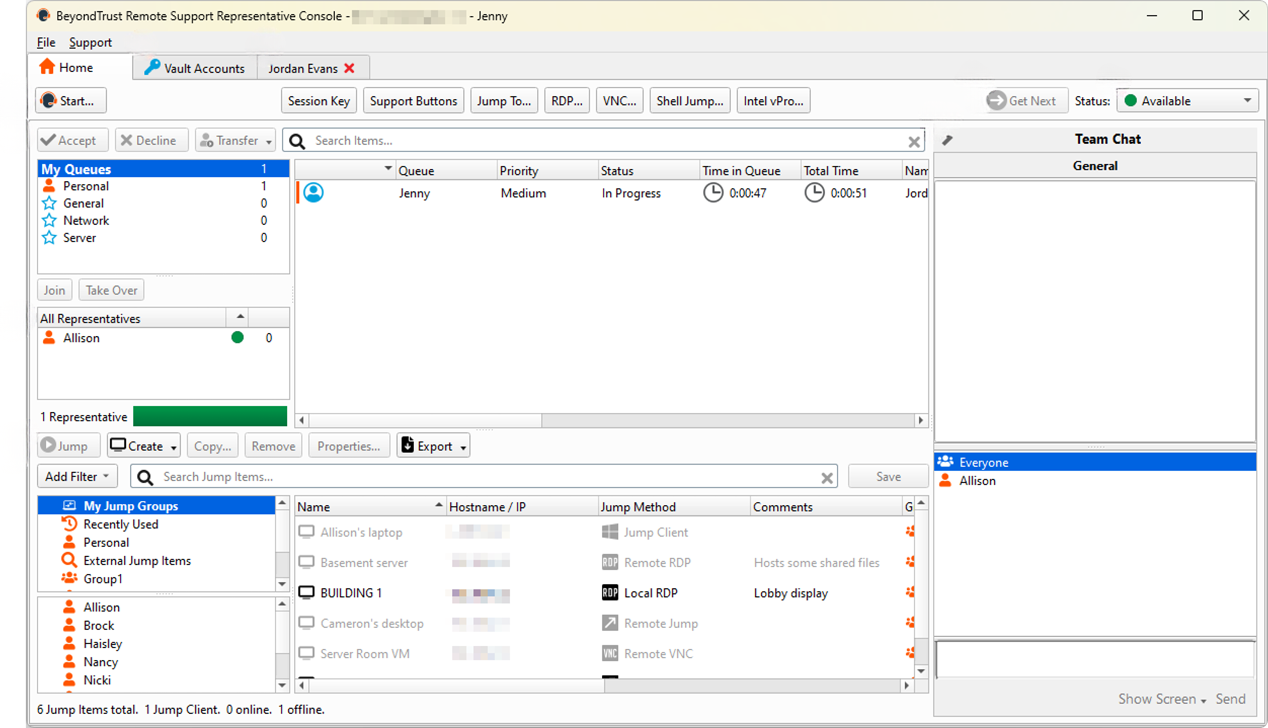
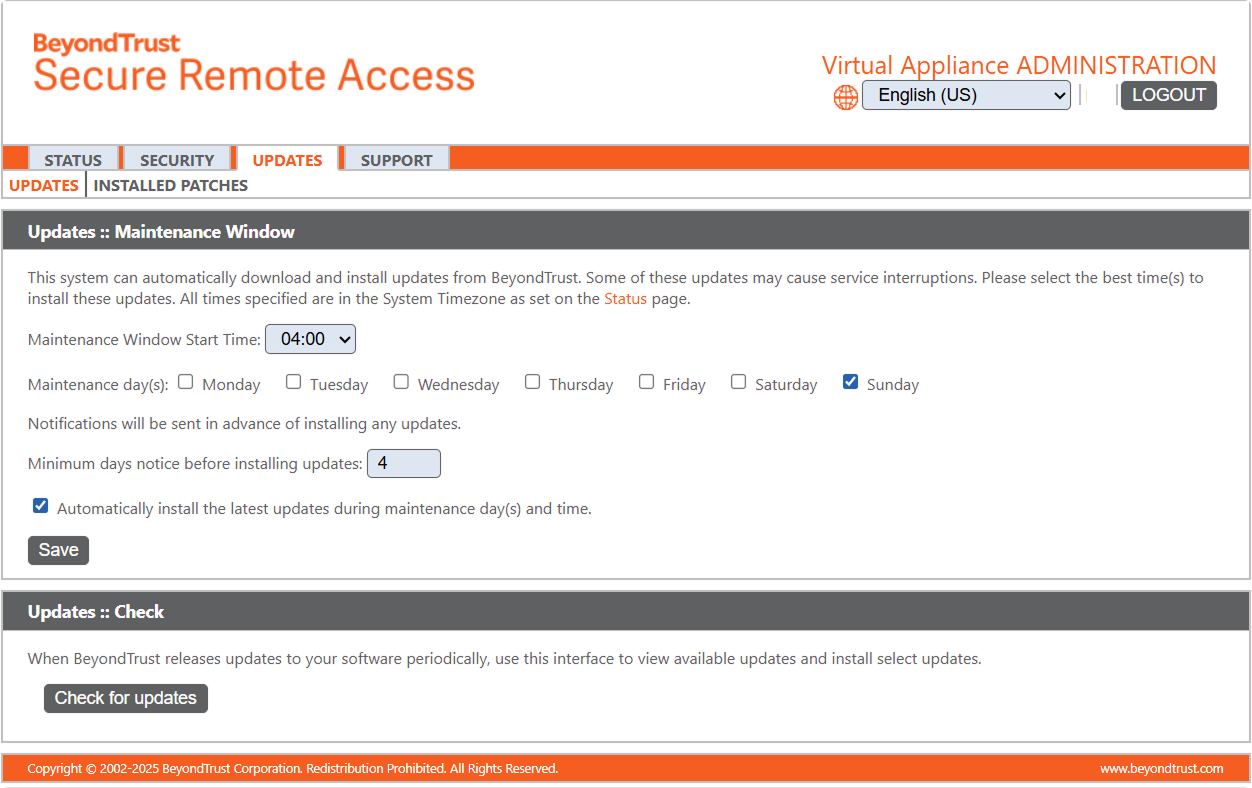
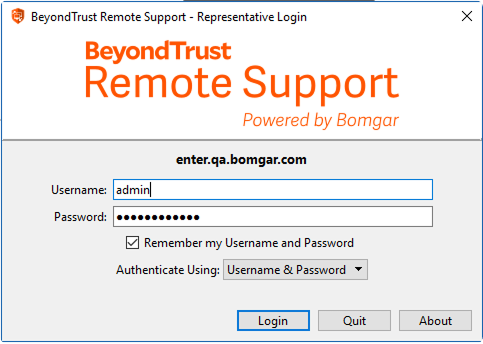
BeyondTrust’s (Bomgar’s) interface is focused on the Representative Console, which is presented on the desktop or through the Web Rep Console. There is also an admin portal with customized controls. Users generally appreciate its enterprise-like look and feel, as well as the convenient grouping of session tools in a toolbar. However, there is a steep learning curve for some functions. After users have configured the tool, it provides predictable and auditable service desk workflows.

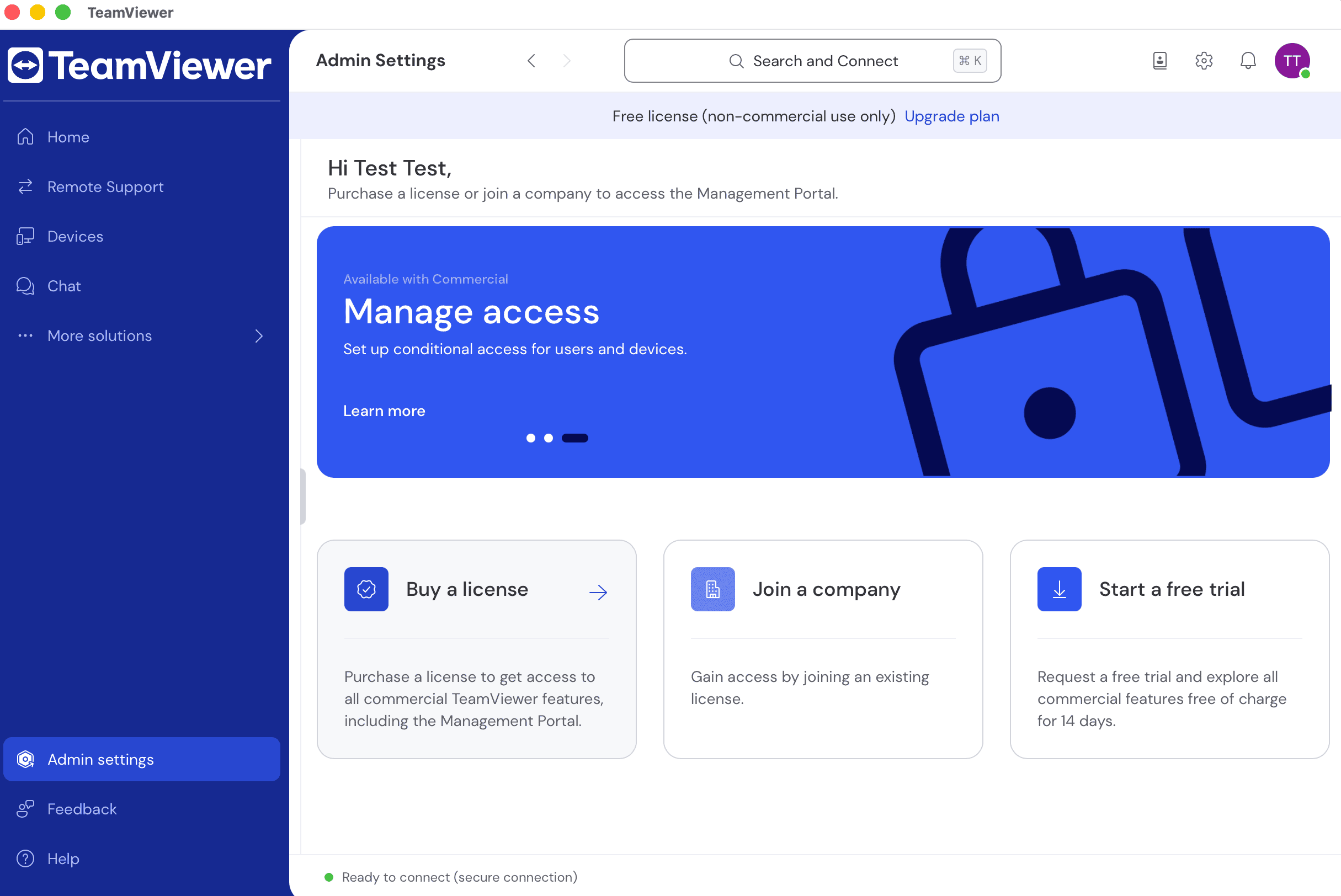
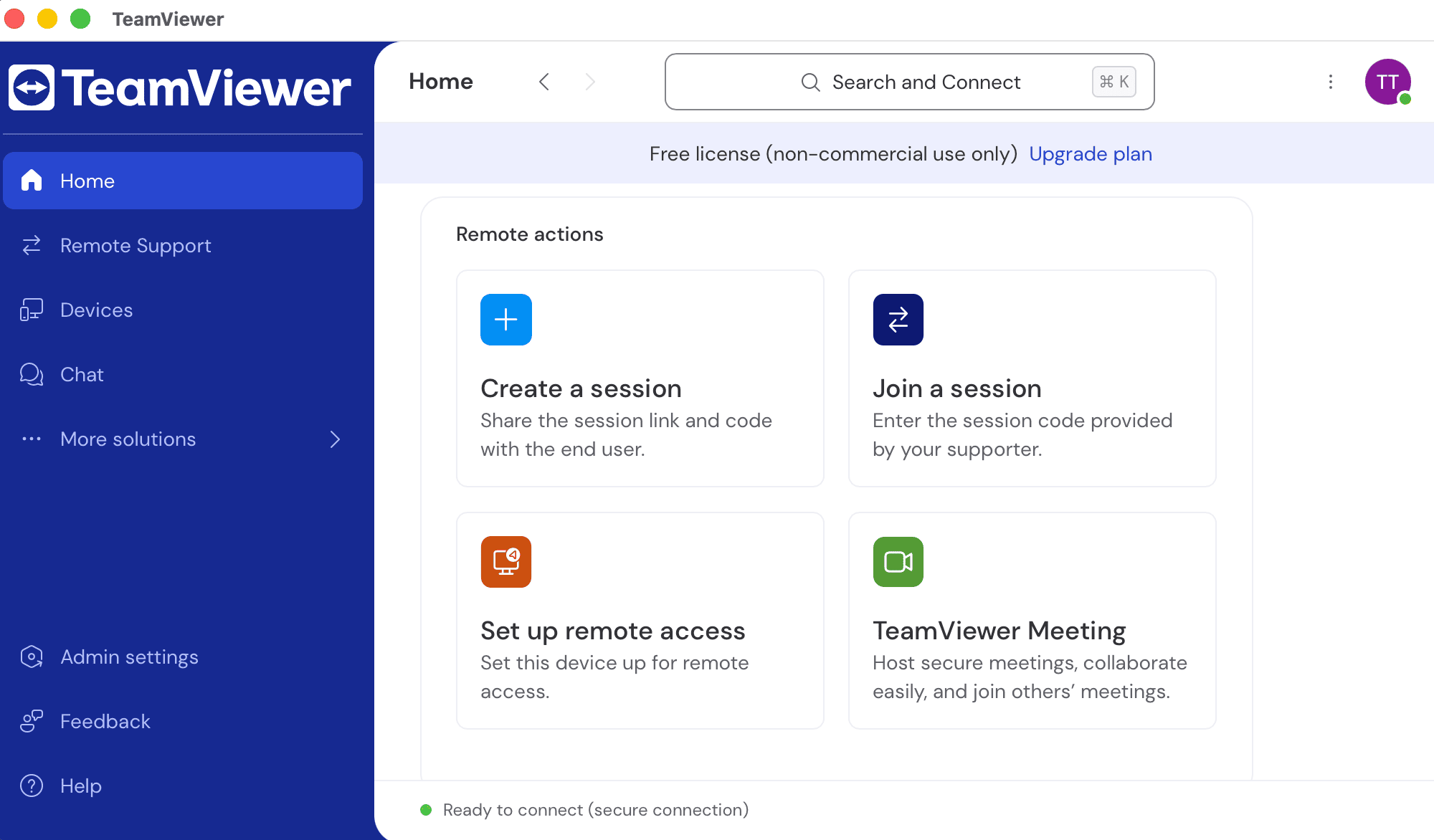
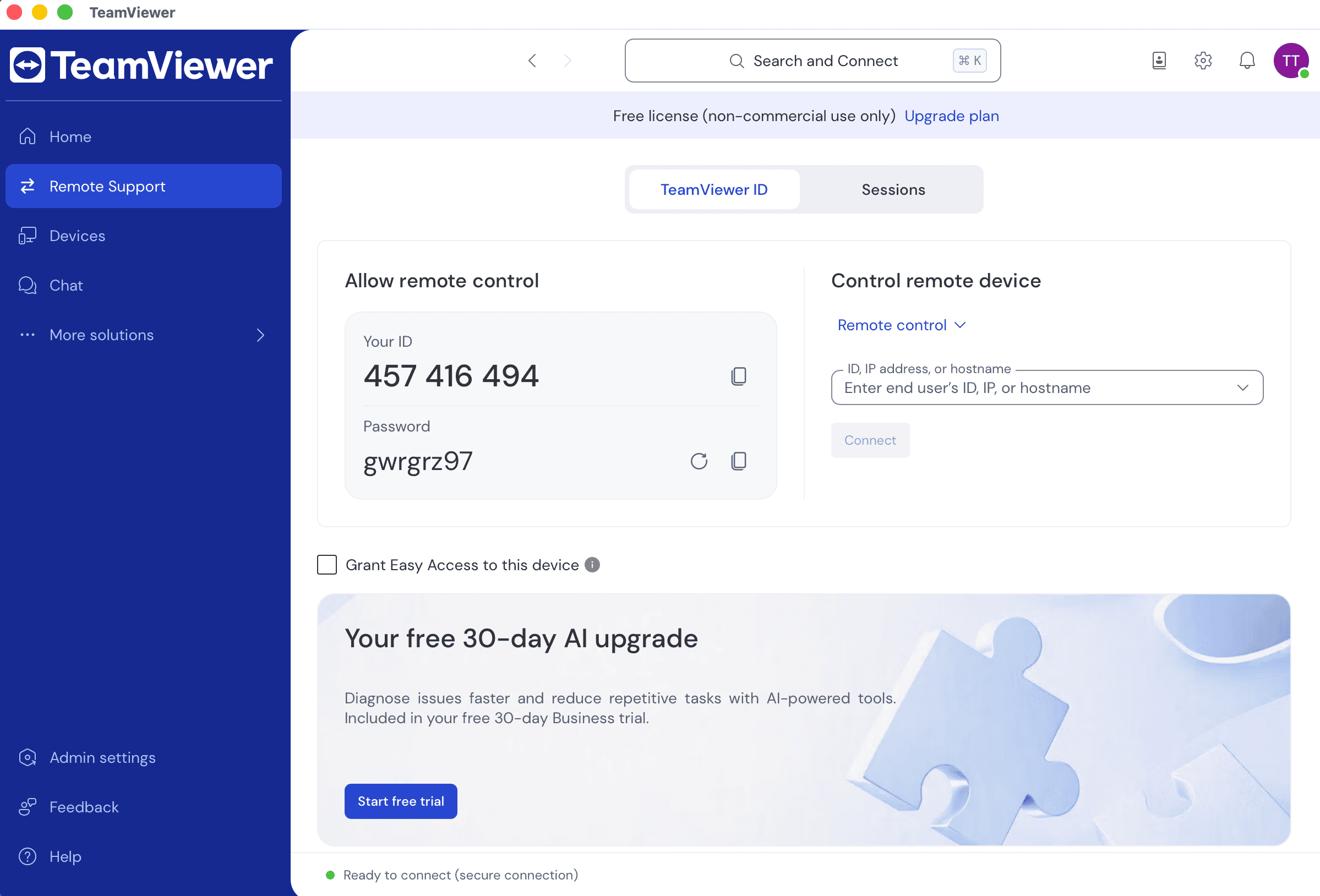
TeamViewer’s user interface is cleaner and designed to facilitate establishing quick ad-hoc connections with features like ID/Password and device lists. The UI offers a consistent, cross-platform layout. Technical users can easily navigate the tool, though some users report frequent updates and less organization as features are added. TeamViewer promotes speed over strict console governance.  

BeyondTrust Remote Support Version 25.2.1
TeamViewer Version 15.80.4

Operating System Support

You must select a remote support tool that reflects your commuting environment. BeyondTrust Remote Support and TeamViewer (Business and Premium) cover all primary desktop and mobile platforms, with some minor differences.

Operating SystemBeyondTrust Remote SupportTeamViewer
(Business & Premium)
Windows
Linux
macOS
ChromeOS (Chromebook sessions;
web-based client has
limited capabilities)
(app/web, screen-share only)
iOS / iPadOS (screen share/remote assistance) (screen share/remote assistance)
Android
FreeBSD
Raspberry Pi (headless support)

TeamViewer vs BeyondTrust Security Comparison

Security is essential in remote access tools that enable technicians to control users’ systems and data. BeyondTrust Remote Support and TeamViewer (Business and Premium) provide security with encryption and access controls using different governance models. The following security details refer to paid plans.

BeyondTrust Remote Support Security

  • • Encryption in transit using TLS with strong ciphers; outbound-only HTTPS (TCP 443) presents a minimal attack surface.
  • • Identity and authentication management with native 2FA, SAML/SSO, and directory integrations. Smart-card authentication is supported.
  • Designed with a least-privilege approach with granular session polices to control actions per portal, endpoint, or rep group.
  • Zero-trust security is supported with network segmentation and single-tenant appliance or private cloud options, safeguarding customer data privacy.
  • Credentials are secured with a built-in credential vault that supports credential injections, allowing technicians to use privileged accounts without needing to know the password.
  • Compliance support is provided with features and deployment options to meet regulations such as GDPR.
  • Auditing is supported with detailed event logs and optional video recording for later review.

TeamViewer (Business & Premium) Security

  • Encryption in transit with RSA public/private key exchanges for handshakes and AES-256 session encryption.
  • Secure connections are brokered through TeamViewer’s global infrastructure.
  • Access governance includes conditional access rules, device-based trust, and easy access for unattended devices.
  • Accounts are protected with 2FA, password strength enforcement, and trusted device lists.
  • Session controls with one-time session IDs and passwords, and logging for reviews and audits.
  • Ecosystem security with SAML SSO and user provisioning (SCIM) in higher tiers.
  • Compliance reporting to support regulated environments is available in enterprise tiers.

Customers should consult the vendor’s most recent security whitepaper and compliance posture to verify that the tool aligns with their regulatory requirements.

Usage Scenarios

The decision to implement BeyondTrust or TeamViewer should primarily rest on how and where you plan to use the platform. Below, we examine how both products address the needs of enterprise service desks, hands-on IT administrators, and individual users. This information can help you quickly find the tool that aligns with your security requirements, licensing needs, and deployment approach.

BeyondTrust (Bomgar)

  • Enterprise help desks – Best used when you want strong governance, auditable workflows, and on-premises or private cloud hosting. Features such as current-rep licensing, granular session policies, credential vault, and comprehensive audit trails support enterprise security and compliance requirements.
  • IT professionals – Best for centralized management of server fleets and network devices. Features supporting these tasks include Jump Clients for persistent access, web console, a real-time KPI dashboard, and least privilege policy controls.
  • Personal use – BeyondTrust is not designed for personal use as it is typically more expensive and too feature-rich.

TeamViewer (Business & Premium)

  • Enterprise help desks – Best when you need a fast rollout for a distributed environment with extensive device support. Features such as ad-hoc connections, remote printing, and tabbed sessions facilitate remote support tasks and problem resolution.
  • IT professionals – Ideal for teams that support multiple OS platforms and require fast remote access to servers and desktops. The tool provides quick connections, multi-monitor functionality, and optional AR add-ons for technicians in the field.
  • Personal use – Good for personal use with a free plan and simple installation for remote access to a home computer to assist family members in resolving issues.

BeyondTrust is a safer choice if you are working in a regulated environment where audits and policy-driven operations are required. TeamViewer is well-suited if you need speed, extensive reach, and minimal administrative overhead for your support teams. TeamViewer is also the best choice for personal use.

Integration

Modern service desks require integration with ticketing, ITSM, and SIEM solutions to enhance productivity and facilitate traceable workflows. The table below looks at the integration features of BeyondTrust Remote Support and TeamViewer (Business & Premium). As the chart indicates, some integrations are only available in TeamViewer’s higher tiers.

Integration FeatureBeyondTrust Remote SupportTeamViewer Business & Premium
REST API
ITSM, such as ServiceNowHigher tiers
CRM, such as SalesforceHigher tiers
Single Sign-On (SSO)Higher tiers
Custom BrandingPremium and above
Directory Integration
Embeddable Web Console

BeyondTrust vs TeamViewer Pricing

When it comes to cost, BeyondTrust and TeamViewer follow very different pricing models.

BeyondTrust is quote-based and typically priced by concurrent representatives, security add-ons, and deployment options. TeamViewer offers tiered U.S. pricing for named users with concurrency via channels, as well as a free personal plan and a 14-day business trial. The difference between named users and concurrent-rep licensing can result in significantly different costs.

BeyondTrust Remote Support Pricing

BeyondTrust does not publish list prices. Potential customers must contact sales for a quote, which will be based on the deployment option, security add-ons, the number of concurrent representatives, and the support tier. Customers may see prices quoted by third-party sources, but should contact BeyondTrust for accurate pricing details.

TeamViewer Pricing

TeamViewer provides pricing details for many versions, with custom pricing for high-tier options. Customers can choose from the following plans.

    • The free version is for personal use only and provides limited functionality and session length.
    • Single-user Remote Access is $24.90 per month. It supports one licensed user, one concurrent connection via a single channel, and three managed devices.
    • Business single-user access costs $50.90 per month and increases the number of managed devices to 200 unattended and unlimited attended endpoints.
    • The Premium Teams version at $112.90 per month supports 15 licensed users, one channel, 300 managed devices, reporting, and up to 10 concurrent sessions per channel.
    • The Corporate Teams offering costs $229.90 per month and supports 30 licensed users, three channels by default, 500 managed devices, up to 15 concurrent tabbed sessions per channel, and advanced rollout options.
    • The Tensor (Enterprise) tier requires custom pricing and is designed for large organizations that require enterprise-grade security and governance.
Pricing plansBeyondTrustTeamViewer
Free Personal
Free Trial14-day trial14-day trial (request)
Level 1$1,995/mo$24.90/mo – Remote Access
Level 2Custom$50.90/mo – Business
Level 3Custom$112.90/mo – Premium
Level 4Custom$229.90/mo – Corporate
Level 5CustomCustom – Tensor/Enterprise

Possible Errors and Restrictions

Below is an overview of the recurring issues and built-in limits users most often encounter with BeyondTrust Remote Support and TeamViewer, along with some potential resolutions to these common issues.

BeyondTrust Remote Support — common issues

    • Firewall/proxy blocks (TCP 443). Reps may see connection failures if the B-Series appliance or cloud endpoint can’t be reached over HTTPS/443. Check your outbound access and SSL inspection rules to isolate the problem.
    • Web Rep Console prerequisites. Users may encounter issues with outdated browsers or restrictive WebSocket/HTTPS settings.
    • Policy-blocked tools.  Support Session Policies can turn off features such as file transfer or clipboard access. Review and modify your policy rules to correct these errors.
    • The Jump Client / Jumpoint is offline. Sessions can’t start if the Jump Clients lose contact or a Jumpoint is unable to reach its target. Check DNS, service status, and network access to identify the issue.
    • Certificate requirements for the iOS Representative Console mandate the use of a CA-signed SSL certificate.
    • IOS controls are limited to screen sharing with BeyondTrust, requiring user action on the device.

TeamViewer — common issues

    • “Commercial use suspected” timeouts can be caused by free accounts flagged for possible commercial activity.
    • “WaitForConnectFailed” indicates the partner did not connect and is usually related to DNS/IPv6 or routing issues. Flush DNS or disable IPv6 to resolve this issue.
    • “Not ready. Please check your connection.” These errors are typically caused by outbound filtering or blocked ports 5938/443/80 that need to be opened for the tool to work correctly.
    • “Unknown session” indicates version, handshake, or permission issues and can be resolved by updating both sides to the same software version.
    • Connection errors can be caused by proxy/SSL inspection interference.
    • Easy Access may require a password when access rights are not set to Full Access or services need to be restarted or reinstalled.
    • Outdated mobile clients typically generate version mismatch / “no route” errors.

Pros and Cons

This section provides an overview of the pros and cons of BeyondTrust and TeamViewer. TeamViewer concentrates on speed and reach via a cloud-first model with a large add-on ecosystem and is licensed based on named users and concurrent channels. BeyondTrust favors on-premises and private-cloud control, as well as enterprise identity and audit capabilities, and is licensed based on the number of concurrent representatives.

BeyondTrust (Bomgar)

"One of the best platforms to connect or control a device remotely"
— Read full review
Pros
  • • Deployment control with an on-premises appliance or private cloud.
  • • Credential vaulting enables credential injection without exposing passwords.
  • • Concurrent-rep licensing so costs align with active technicians.
  • • Enterprise integrations with SSO/LDAP/ITSM/SIEM solutions.
  • • Web rep console features a complete toolkit via browser.
Cons
  • • Quote-based pricing can be high and difficult to budget.
  • • License specifics vary with the contract and deployment.
  • • iOS/ChromeOS provides screen sharing but no complete control.
  • • Steep learning curve and complex rollout.
  • • No native remote printing capability.
  • • Network dependencies with 443/WebSockets/proxy allowances required.

TeamViewer (Business & Premium)

"Reliable and Easy-to-Use Remote Support Tool"
— Read full review
Pros
  • • Fast SaaS rollout and quick, ad-hoc connections.
  • • Broad platform support for desktops, mobile devices, and Raspberry Pi.
  • • Convenient file operations with drag-and-drop transfers and remote printing.
  • • Tabbed sessions for streamlined multitasking.
  • • Large ecosystem of integrations and add-ons for additional functionality.
  • • Free personal and 14-day business trial for comprehensive evaluation.
Cons
  • • Costs can quickly scale as more channels and users are added.
  • • Administrative overhead with frequent prompts and a heavier client.
  • • Commercial-use flags may cause timeouts on the free plan.
  • • Entry-tier limits the number of devices and concurrent sessions.
  • • Strict networks need allow-listing (5938/443/80) to open channels.
  • • Advanced integrations require higher tiers.

Final Thoughts

BeyondTrust Remote Support is best for enterprise service desks in regulated environments where FIPS 140-2 validation, audit trails, and least-privilege controls matter. Its drawbacks are quote-based pricing, a heavier rollout, and concurrent-representative licensing that requires capacity planning.

TeamViewer fits distributed IT teams that need broad platform coverage, mature paid features, mobile support options, and a large integration ecosystem. Its downsides are channel-based concurrency, mobile support add-ons, annual subscription renewal, and a free tier limited to personal use.

HelpWire is the better fit for IT support teams, solo providers, and internal SMB IT that prioritize fast session start, session continuity, and simple team concurrency. Its free subscription supports personal and business use with no nag screens or session timeouts, and Quick Connect allows ad-hoc attended support without creating an account.